
Your nervous system isn’t designed to stay calm—it’s built to mobilize, then recover. Regulation means flexibility: shifting from sympathetic activation into parasympathetic rest via your vagus nerve, which handles about 75% of that calming work. When this balance breaks down, you’ll notice signs like wired-but-tired sleep, brain fog, or a hair-trigger startle response. The good news? Science backs specific techniques—breathwork, movement, co-regulation—that rebuild this balance. Here’s what actually works.
TLDR Key Takeaways
- Regulation means flexibility to shift between sympathetic and parasympathetic states, not constant calm.
- Neuroception drives unconscious safety/threat scanning, shaping dysregulation from trauma, stress, or genetics.
- Chronic overactivation shows as muscle tension, poor sleep, racing thoughts, or emotional numbness and brain fog.
- Vagal tone biomarkers (HRV, RMSSD, HF power) objectively track recovery, resilience, and cognitive function.
- Techniques like physiological sighing, box breathing, and cold exposure rapidly restore parasympathetic balance.
What Nervous System Regulation Really Means

When people hear “nervous system regulation,” they often envision staying calm no matter what—but that’s not quite right. Regulation isn’t about suppressing activation; it’s about flexibility.
Your nervous system is built to respond to stress and return to balance afterward. That means mobilizing when you need to act, then recovering when the threat passes.
This happens through a cascade of physiological responses—your sympathetic system revs you up, your parasympathetic system brings you back down. This shift from sympathetic dominance to parasympathetic activation is essentially what people mean by regulation. When this balance is lost, the system can remain on high alert or shut down even without real danger present. Dysregulation can stem from trauma, chronic stress, infection, or even genetic factors.
You gain this flexibility through situational awareness: recognizing what a situation actually demands from you. Rhythmic breathing supports this shift, signaling safety to your body so it can move out of high alert.
Real regulation means you can mobilize, rest, connect, or protect yourself—then return to baseline efficiently, without getting stuck in any single state.
Sympathetic vs. Parasympathetic: How the Balance Works
This flexibility depends on two branches of your autonomic nervous system working in constant, coordinated opposition. Your sympathetic branch drives fight-or-flight—releasing adrenaline and noradrenaline, quickening your heart rate, dilating pupils, and redirecting blood toward your extremities for immediate action. Your parasympathetic branch counters this through rest-and-digest functions, slowing your heart rate via the vagus nerve and stimulating digestion when you’re safe. The vagus nerve alone makes up about 75% of the parasympathetic nervous system, connecting to the heart, lungs, and abdomen.
This autonomic interplay isn’t random. When one system ramps up, the other typically dials down, functioning like a finely tuned see-saw. Yet you’re never operating in just one mode—autonomic tone keeps both systems simultaneously active in the background. Your body constantly makes homeostatic shifts, recalibrating this balance based on real-time demands rather than staying locked in a fixed state. Chronic overactivation of the sympathetic branch has been linked to high blood pressure, anxiety, and sleep problems. Beyond the heart and gut, this same sympathetic activity extends into your immune organs, where it can either heighten or dampen inflammatory responses depending on which adrenergic receptors are engaged. Understanding this mechanism gives you real influence over your own physiology.
Signs of a Dysregulated Nervous System
Often, a dysregulated nervous system doesn’t announce itself with a single dramatic symptom—it shows up as a pattern of smaller signals your body sends when the sympathetic-parasympathetic see-saw stops balancing properly.
You might notice chronic tension in your jaw, neck, or shoulders that never fully releases, even when you rest. Your sleep suffers—you’re wired but tired, unable to power down despite exhaustion.
Digestive issues, racing thoughts, or an exaggerated startle response signal your body’s stuck in protection mode. Research links gut discomfort and irritable bowel symptoms to reduced vagal modulation.
On the flip side, you might feel emotional numbness—disconnected from your body, unable to access joy or sadness clearly. This kind of parasympathetic dominance can also show up as excessive sleep, low energy, and general disengagement.
Brain fog, irritability, and slow recovery from stress round out the portrayal. Cognitive symptoms like these often include persistent worry, memory problems, and poor judgment.
These aren’t character flaws. They’re your nervous system asking for regulation, not willpower.
Why Vagal Tone Matters for Long-Term Resilience

Underneath these scattered signals sits a single physiological thread worth understanding: vagal tone. This isn’t abstract theory—it’s a measurable biomarker of how efficiently your nervous system recovers, thinks, and protects you long-term. High vagal tone brakes your heart rate under stress, sharpens executive function when pressure mounts, and buffers you against anxiety and trauma symptoms after adversity. It’s also protective at the cellular level, supporting cardiovascular health and dampening inflammation over years, not just moments.
Vagal biomarkers give you a concrete way to track your progress instead of guessing. And because vagal tone responds to consistent resilience training—breathwork, movement, self-compassion practice—you’re not stuck with the nervous system you have now. You’re building the one you actually want. Improvements from these practices typically emerge over weeks rather than days, so patience and consistency matter more than intensity. This tracking capacity matters because the vagus nerve itself governs interoception—your ability to perceive and interpret internal bodily states—making vagal tone training a direct route to better body awareness. Research from the University of North Carolina has also linked greater autonomic flexibility to increased positive emotions and stronger social connectedness.
Fast Nervous System Regulation Techniques That Work
Sometimes you don’t need years of resilience training—you need relief in the next sixty seconds. That’s where breath hacks come in. A physiological sigh—double inhale through the nose, long exhale through the mouth—reinflates collapsed air sacs fast.
Box breathing (4-4-4-4) or a 4-count inhale with an 8-count exhale settles your vagus nerve within minutes.
Cold immersion works even faster. Splashing cold water on your face or wrists triggers the mammalian diving reflex, dropping heart rate and shifting you toward parasympathetic dominance in under a minute. Hold it for at least sixty seconds to let the response kick in.
Pair these with a minute of shaking out tension or humming on your exhale, and you’ve got real, immediate control—no waiting required. Gentle tremoring, as described in Somatic Experiencing, mimics the way animals naturally discharge stress hormones after a threat has passed. These quick resets work because deep breathing signals safety to the brain and slows the heart rate, nudging you out of sympathetic dominance almost immediately. If you’re unsure which method fits your state, orienting through slow neck turns is a reliable starting point since it applies broadly regardless of whether you’re wired or numb.
Why Stanford Backs the Physiological Sigh
This isn’t just a feel-good trick—Stanford researchers put it to the test, and the data back it up. Published in Cell Reports Medicine, the study behind this Stanford endorsement compared cyclic sighing directly against mindfulness meditation. The results were clear: five minutes of daily practice outperformed meditation on every measurable front—greater mood improvement, lower respiratory rate, and stronger stress reduction (p < 0.05).
This isn’t anecdotal wellness advice. It’s backed by real clinical trials with measurable outcomes on PANAS scores and physiological markers. Participants didn’t just feel calmer—they reported feeling more in control of their emotions and bodies.
You don’t need faith to try this. You need five minutes and a willingness to breathe differently. The science already did the heavy lifting.
Track Your Progress With HRV Biofeedback

Numbers don’t lie, and HRV biofeedback gives you plenty to track. Your progress metrics center on a few key markers: SDNN measures overall variability improvement, HF power validates enhanced parasympathetic function, and RMSSD tracks successive heartbeat changes. Coherence—typically peaking around 0.10 Hz—signals emotional stability and sharper cognitive function.
You’ll want to establish your personal resonance breathing rate first. This isn’t one-size-fits-all; your ideal frequency depends on individual respiratory patterns, usually landing between 5 and 6 breaths per minute. Once you’ve locked in that rate, consistent practice matters more than perfection. Research confirms clinical improvements correlate directly with rising HRV indices over time.
Track these numbers weekly. You’ll see tangible proof that your nervous system is recalibrating—not just feeling calmer, but measurably regulating itself.
How Movement Calms Your Nervous System
Tracking your HRV data tells you what’s happening internally, but movement gives you a direct lever to pull. Mindful movement activates your parasympathetic nervous system, shifting you out of fight-or-flight and into rest-and-digest. Slow, rhythmic motion paired with deep breathing lowers cortisol, enhances endorphins, serotonin, and dopamine, and strengthens vagal tone. This isn’t abstract—it’s proprioceptive grounding in action: your brain reads sensory feedback from your muscles and joints as evidence of safety, calming neural activity in real time.
You don’t need extreme workouts to feel this. Five to ten minutes of gentle yoga, a brisk walk, or a swim can shift your physiology. Moderate, consistent movement builds lasting regulation; excessive intensity works against you.
Environmental Scanning: A Simple Safety Signal
Constantly, your nervous system runs a background check on your surroundings—scanning for signs of safety or threat without asking your permission first. Dr. Stephen Porges named this process neuroception, and it happens below your conscious awareness, every microsecond, shaping your physiology and behavior before you even register what’s happening.
You can work with this system instead of against it. Slow scanning—deliberately looking around your environment and naming what you see—activates your rational neocortex and quiets limbic system reactivity. Try naming five things you see, four you hear, three you feel.
This orienting technique interrupts freeze, flight, or fight responses, returning you to the present. Safety cues you notice—soft light, familiar objects, open space—tell your body it’s free to stand down.
Why Co-Regulation Through Connection Works
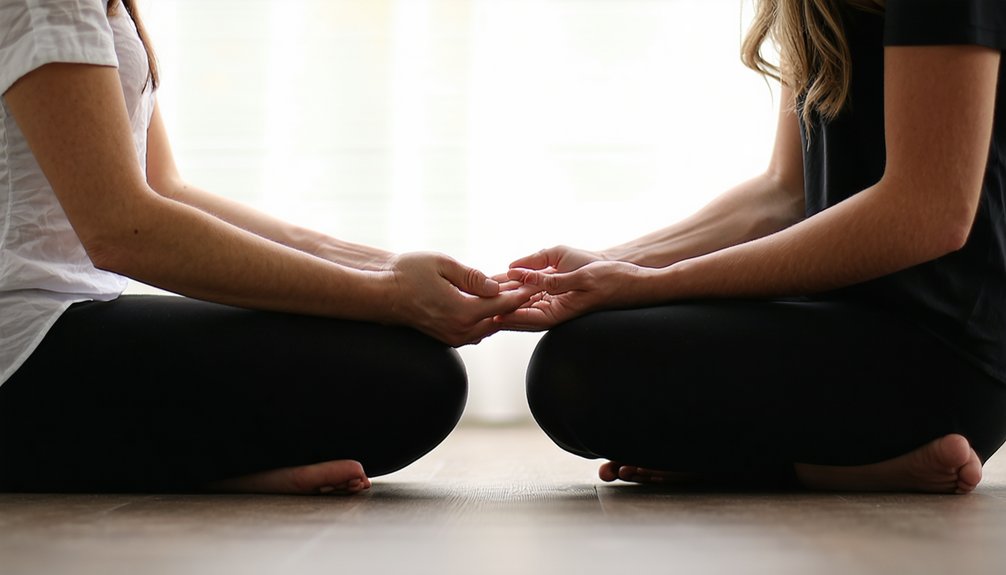
In the presence of another regulated nervous system, yours doesn’t stay dysregulated for long—it starts syncing up. This isn’t willpower or wishful thinking; it’s biology. Mirror neurons fire automatically, letting your brain mimic the calm state of the person beside you. Your heart rate and breathing begin entraining to theirs, easing physiological stress without conscious effort. Oxytocin bonding kicks in too, dampening the amygdala’s fear response and softening your threat perception. Even your brainwaves shift—EEG studies show measurable synchrony in alpha and theta bands when connection deepens.
This is why isolation keeps you stuck and connection sets you free: your nervous system was never meant to regulate alone. Co-regulation isn’t dependency—it’s your biology reclaiming safety through genuine, differentiated connection with another human being.
Catch Dysregulation Early With Interoception
Co-regulation works because another person’s calm nervous system gives yours something to sync with—but you still need to notice your own state shifting before you can meet theirs. That’s interoception: the conscious and subconscious read of your internal state.
Your brainstem, thalamus, and insula integrate bodily signals; your anterior cingulate and somatosensory cortex catch the subtle shifts before full dysregulation hits. A racing heart, tightening gut, or unexplained anxiety after eating are visceral prediction errors—your brain’s map not matching your body’s reality.
Chronic stress and disrupted early attachment can blunt this accuracy, but interoceptive training rebuilds it. You’re not broken for missing these signals; you’re under-practiced. Sharpen this skill, and you catch dysregulation at its root—before it hijacks you.
Build Nervous System Regulation Into Daily Life
Regularly practiced breathwork gives you the fastest lever for shifting your nervous system state. Try diaphragmatic breathing, the 4-7-8 method, or a physiological sigh to move from alert to calm within minutes. Pair this with rhythmic movement: short exercise snacks, a walk outdoors, or gentle stretching reset your baseline and lower cortisol.
Build micro pauses into your day. Let a phone chime prompt you to check in, name your emotional state, or take three slow breaths before a meeting. These small interruptions stop stress from compounding.
Ground yourself physically through progressive muscle relaxation, temperature shifts, or the 5-4-3-2-1 method. Try breath journaling to track patterns and notice what actually works. Freedom comes from consistency, not perfection—small daily practices rewire your baseline over time.
Frequently Asked Questions
How Long Does It Take to Notice Results From These Techniques?
You’ll feel short term improvements—calmer states, better sleep—within days to a few weeks of consistent practice. Long term adaptations, like lasting resilience and a new baseline, typically take 2–6 months of dedicated, daily commitment to your freedom.
Can Children or Teens Practice Nervous System Regulation Methods Safely?
Yes, you can practice these methods safely. You’ll get the best results through play based exercises and parent guided practice, using age-appropriate breathing, movement, and sensory techniques that strengthen your child’s natural regulation abilities without medical risk.
Are There Any Risks to Practicing Box Breathing or Physiological Sighs?
Yes, you may notice lightheadedness risk if you breathe too forcefully, and over-breathing fatigue can creep in with extended practice. Start slow, listen to your body, and stop if discomfort arises—your autonomy matters.
Should I Consult a Doctor Before Starting HRV Biofeedback Training?
Yes—if you have specialized contraindications like hypertension, cardiovascular disease, anxiety disorders, or pregnancy, you need medical clearance first. Otherwise, you’re free to investigate HRV biofeedback independently and reclaim your autonomic self-regulation without unnecessary gatekeeping.
Can Medication Affect Vagal Tone or Nervous System Regulation Efforts?
Yes—medications like beta-blockers, calcium channel blockers, and cholinergic drugs directly alter your vagal tone through medication interactions and autonomic side effects. You deserve full transparency here: know your prescriptions, track your body’s responses, and reclaim informed control over your regulation practice.
Conclusion
Your nervous system isn’t something you fix once—it’s something you train, day after day. You don’t need hours of practice; you need consistent, small signals of safety: a few deep breaths, a scan of your environment, a moment of connection with someone you trust. Track your interoceptive cues, catch dysregulation early, and respond before it snowballs. Regulation isn’t about eliminating stress—it’s about building the flexibility to move through it and return to baseline.
References
- https://www.birchwoodclinic.com/the-myth-of-regulating-your-nervous-system/
- https://continuing.mcmaster.ca/mastering-the-art-of-self-regulation-5-tips-to-soothe-your-nervous-system/
- https://positivepsychology.com/nervous-system-regulation/
- https://www.youtube.com/watch?v=YcoIE3Yiaw0
- https://my.clevelandclinic.org/health/body/21202-nervous-system
- https://www.theguardian.com/wellness/2024/mar/04/what-is-nervous-system-dysregulation
- https://www.simplypsychology.com/articles/nervous-system-regulation
- https://pmc.ncbi.nlm.nih.gov/articles/PMC10453544/
- https://anniewright.com/nervous-system-regulation/
- https://acp-mn.com/about-acp/blog/how-to-heal-a-dysregulated-nervous-system/

