
Your preventive care needs shift almost every decade, and as a Black woman, you often benefit from starting key screenings earlier than standard guidelines suggest. You’ll want annual visits from 18, cervical screening at 21, and diabetes checks as early as 30 if you’re high-risk. Mammograms and colonoscopies typically should start around 38-45, not later. Bone density and lung screening matter too. Here’s your complete calendar, decade by decade.
TLDR Key Takeaways
- Start annual preventive visits at 18, tracking blood pressure, BMI, HIV, hepatitis C, and cholesterol.
- Begin cervical cancer screening at 21, transitioning to HPV testing options after age 30.
- Consider diabetes and cholesterol screening earlier, especially with risk factors like hypertension or family history.
- Start breast cancer risk assessment by 25–30, since Black women often need earlier mammograms.
- Get annual STI testing if under 25 or sexually active with risk factors, using NAAT-based methods.
Your Preventive Care Calendar Starts at 18

Once you turn 18, your preventive care calendar officially kicks in—and it doesn’t stop for the rest of your life. This age marks a critical shift planning milestone: you’re moving from pediatric care to adult healthcare ownership, and your body deserves a proactive strategy from day one.
Your preventive priorities start here. Every exam should include blood pressure, height, weight, and BMI checks. You’re eligible for one-time HIV testing (ages 15–65) and hepatitis C screening (ages 18–79). If you’re sexually active, chlamydia and gonorrhea screening applies through age 24. Lipid screening happens once between 17–21. Suicide risk screening runs through age 21, alongside birth control conversations. Cholesterol screening should also officially begin at age 20, with retesting every 4–6 years if you’re low risk. WPSI also recommends at least one preventive care visit per year beginning in adolescence and continuing across your lifespan.
This is your baseline. Own it—your future health depends on the habits you build right now.
Cervical Cancer Screening Guidelines for Ages 21–29
Turning 21 flips the switch on your cervical cancer screening routine: it’s time for your first Pap test. Cytology alone, every 3 years—that’s the standard set by USPSTF, ACOG, and ACS/ASCCP/ASCP alike. Skip HPV testing and co-testing for now; transient HPV infections are common at this age and can trigger false positives without improving outcomes. Don’t let anyone push annual screening or early testing before 21—it’s not evidence-based, and it’s not necessary.
This age bracket calls for age specific counseling: know why the 3-year interval works and why cytology alone is enough. Pair that knowledge with a screening barriers analysis—identify what’s standing between you and consistent care. For Black women, closing the mortality gap starts with claiming this schedule as non-negotiable. Current guidelines note that this age group applies to those with no history of abnormal screening, since prior abnormal results require individualized plans. Nationally, cervical cancer deaths dropped from 2.8 to 2.3 per 100,000 women between 2000 and 2015, a gain largely credited to widespread screening. Your Pap sample is collected using a speculum and a soft brush or tiny spatula during a pelvic exam.
What Changes in Cervical Cancer Screening After 30
At 30, your screening options expand—and so does the interval between tests. You now have three paths: primary HPV testing alone every 5 years, co-testing (Pap plus HPV) every 5 years, or Pap-only every 3 years.
This is the HPV preference era—guidelines now favor hrHPV testing alone as the go-to method for average-risk women 30–65. The ACS backs this shift, too, recommending HPV testing every 5 years starting at 25.
These extended intervals aren’t about cutting corners—they reflect what the evidence shows: HPV testing catches risk earlier and more reliably than cytology alone. That means fewer appointments, less anxiety, and more trust in the science protecting your body. If you choose Pap-only screening and results come back normal, you’ll return to a three-year interval. Talk to your provider about which option fits your life. Women with certain conditions, such as HIV infection, may need more frequent screening than these standard intervals suggest. Left unchecked, cervical cancer affects more than 13,000 women diagnosed each year in the US, underscoring why staying on schedule with these screenings matters so much.
STD Testing Rules for Sexually Active Women

STD testing isn’t one-size-for-all—it shifts based on your age, risk profile, and sexual history. If you’re under 25 and sexually active, you need annual chlamydia and gonorrhea screening—no exceptions.
Once you hit 25, testing depends on risk factors: new partners, multiple partners, a partner with other partners, a partner with a diagnosed STI, or a history of transactional sex. If you’re pregnant, guidelines recommend routine screening for all pregnant women regardless of age, since ACOG supports routine screening for all pregnant women.
NAAT is your gold-standard testing method, working with urine, vaginal, or endocervical samples. If you’ve had rectal or oral exposure, ask about extragenital screening—it catches infections urogenital tests miss. These infections are often asymptomatic but left untreated can progress to pelvic inflammatory disease.
Don’t have time or access to a clinic? Home collection kits let you self-swab or collect urine, then mail samples for confidential results. Many of these kits are FDA-approved for chlamydia, gonorrhea, HIV, and syphilis, giving you added confidence in their accuracy.
If you test positive, retest three months post-treatment to confirm you’re clear.
HPV Vaccination Guidelines Through Age 45
The FDA expanded Gardasil 9’s approval in October 2018, opening it up to everyone ages 9 through 45. Gardasil 9 remains the only HPV vaccine available in the US, and age specific dosing determines your schedule.
Start before 15, and you’ll need just two doses, 6 to 12 months apart. Start at 15 or later, and you’ll need three doses over six months.
Routine catch-up vaccination runs through age 26, no risk-factor questions asked. Between 27 and 45, it’s shared decision making: talk with your provider about your exposure risk and potential benefit. This approach reflects the fact that vaccination benefits are reduced for this age group due to prior HPV exposure. Importantly, ACIP has not recommended routine catch-up vaccination for all adults in this 27-45 age range, which is why individual consultation matters so much.
Since hitting all nine HPV types is unlikely, vaccination can still protect you even with prior exposure. No HPV DNA testing is needed beforehand—just get vaccinated. The vaccine offers strong protection, providing >99% efficacy against HPV types you haven’t already encountered.
Diabetes Screening Starts at 35 for Black Women
Mark your calendar for 35—that’s when USPSTF now recommends diabetes screening kick in for overweight or obese adults, down from the previous threshold of 40. This shift opens screening access to 12 million more Americans, but as a Black woman, you deserve to know your risk profile demands earlier screening.
You’re classified high-risk by ADA guidelines, and research suggests optimal testing may start as early as 30. Add any risk factor—hypertension, family history, gestational diabetes—and you should get screened at any age, no waiting required.
Don’t leave this to chance. Push for community outreach in your neighborhood that brings screening directly to Black women. Know your numbers early. Despite these expanded guidelines, disparities persist since Hispanic adults, low-income, and uninsured populations still show lower testing rates. Advocate loudly. Your health timeline isn’t up for negotiation.
Baseline Mammograms and Cholesterol Checks in Your 30s

Diabetes isn’t the only number you need to track early—your breast cancer and heart health timelines matter just as much.
By 30, you should already have a baseline breast cancer risk assessment behind you, ideally started between 25 and 30. Early mammograms aren’t premature—they’re strategic. Race-adapted screening data shows you may need to start about eight years earlier than white women, meaning age 34–38 depending on the guideline used. If you have heightened risk or family history, don’t wait until 40.
Your heart deserves the same urgency. Lipid monitoring should begin in your 20s or 30s, especially since cardiovascular disease disproportionately threatens Black women. Get your cholesterol checked, know your numbers, and repeat every 4–6 years—or sooner if risk factors exist.
This is your health, on your terms.
Breast Cancer Screening Ramps Up at 45
Forty-five marks a turning point most guidelines agree on—but for Black women, it shouldn’t feel like the starting line. The American Cancer Society recommends annual mammograms starting at 45 for average-risk women, while NCCN pushes that threshold to 40. USPSTF backs biennial screening from 40 to 74, citing significant benefit for Black women starting at 40.
Here’s the truth: age specific guidelines built on average-risk data don’t account for you. Black women face earlier diagnoses and more aggressive tumor subtypes. Research suggests screening should start around age 38 to match true risk levels—not 45.
Waiting until 45 or 50 deepens screening disparities already working against you. Advocate for earlier, annual screening. Your body deserves protocols built for your reality, not someone else’s average.
Colon Cancer Screening Starts Five Years Early for Black Women
While most guidelines eventually caught up to age 45, the reasons behind that shift matter more than the number itself. You face a 20% higher incidence of colorectal cancer, often diagnosed before 50, and frequently in the distal colon—harder to catch with some stool tests. Starting screening at 45 isn’t a courtesy; it’s a correction for decades of delayed diagnosis and lower access.
You’ve got options: colonoscopy every 10 years, FIT annually, mt-sDNA every 3 years, CT colonography every 5 years, or flexible sigmoidoscopy every 5 years. If a parent or sibling had colorectal cancer, start 10 years before their diagnosis age.
Earlier detection saves lives. Push for community outreach that brings screening resources directly to you—your body deserves that protection.
Bone Density Testing and Osteoporosis Risk After 55
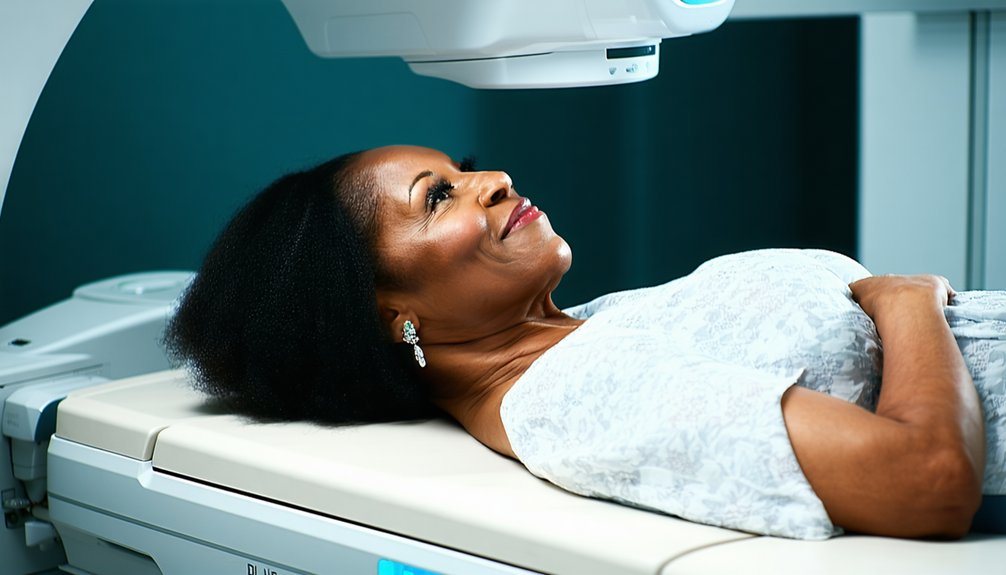
Colon cancer isn’t the only place where delayed screening puts you at risk—your bones tell a similar story. You’re due for routine DXA screening at 65, but if you’re postmenopausal with risk factors—family history, vitamin D deficiency, smoking, chronic glucocorticoid use, or frequent falls—you need assessment sooner. Yet documented racial disparities mean Black women often face delayed referrals compared to Caucasian women, even with equal risk.
Know your numbers: a T-score of -1.0 or above is normal; -2.5 or below confirms osteoporosis. Demand a fracture risk assessment if you’re under 65.
Fracture prevention strategies start now—push for bone strength nutrition, request DXA testing directly, and don’t accept “wait and see” as an answer.
Mammogram and Pap Test Changes for Women 65
Turning 65 doesn’t mean screening stops—it means the rules shift.
For mammograms, keep going every 1-2 years through your early 70s. Major organizations back regular screening for women 70+ in good health. Past 74, the evidence gets murky—science hasn’t confirmed whether routine mammograms still help. This is where shared decision making with your provider matters most, including honest life expectancy discussions grounded in your actual health status, not just your age.
Pap tests can often stop at 65—but only if you’ve had three clean Pap results or two negative HPV tests in the last decade, with your most recent test within 5 years.
Exception: if you’ve been treated for precancerous cervical lesions, screening continues 20 years post-treatment or until 65—whichever stretches longer. Your history determines your timeline, not your birthday.
Lung Cancer Screening for Longtime Smokers
Smoking history changes your screening math entirely. If you’re 50 to 80 years old with at least 20 pack-years of smoking—and you currently smoke or quit within the past 15 years—you qualify for annual LDCT screening. This low-dose CT scan catches lung cancer early, when treatment can actually cure it. The data backs this up: LDCT screening cuts lung cancer death risk by 20% compared to no screening.
Screening stops at 81, or once you’ve been smoke-free for 15+ years, or if health issues rule out curative treatment. Before you start, talk with your doctor through shared decision making—reviewing benefits, limits, and potential harms together.
Your history doesn’t disqualify you. It’s exactly why this screening exists.
Frequently Asked Questions
Does Insurance Typically Cover These Preventive Screenings at No Extra Cost?
Yes—your insurance coverage typically pays for preventive screenings at no cost when you use in-network providers. You won’t owe copays or deductibles. Always confirm with your insurer first, though, since plans vary and follow-up tests may cost extra.
What Lifestyle Changes Can Lower Diabetes and Heart Disease Risk Before Screenings Begin?
Start a diet overhaul: swap butter for olive oil, load up on veggies and beans, cut sodium. Add 30 minutes daily movement. Practice stress reduction through yoga, breathing, laughter. You’re reclaiming your health, one choice at a time.
Should Family History Change the Recommended Age to Start Any of These Screenings?
Yes—your family history drives personalized timing. If relatives had early colon cancer, start colonoscopies sooner. Family heart attacks before 50 mean cholesterol checks at 20. Own your history; demand screenings that fit *you*, not generic guidelines.
How Do I Find a Doctor Who Specializes in Black Women’s Preventive Health Needs?
Use directories like Find A Black Doctor to locate culturally competent providers near you. Filter by specialty, check credentials, and read testimonials. Ask trusted community referrals—friends, family, local networks—who prioritize your autonomy, safety, and whole-person preventive care.
What Symptoms Should Prompt Earlier Testing Instead of Waiting for Scheduled Screenings?
Don’t wait if you notice unexpected bleeding, breast lumps, skin changes, or persistent fatigue paired with weight loss or appetite changes. Your body’s signals matter—trust them. Advocate for immediate testing; you deserve answers now, not later.
Conclusion
Your health doesn’t wait, and neither should you. From your first Pap smear at 21 to lung cancer screenings in your 50s and 60s, each stage of life brings new tests you need. Track these milestones, mark them on your calendar, and talk to your doctor about your personal risk factors. Staying ahead of screenings gives you the best shot at catching problems early—when they’re most treatable.
References
- https://medlineplus.gov/ency/article/007462.htm
- https://www.urologyhealth.org/documents/Product-Store/English/GeneralHealth-BlackWomenHealth-POS-2024-English.pdf
- https://cretscmhd.psych.ucla.edu/healthfair/HF Screenings/screenings_women.pdf
- https://www.hopkinsmedicine.org/health/wellness-and-prevention/womens-preventive-care-infographic
- https://blackdoctor.com/must-have-tests-for-black-women/
- https://newsnetwork.mayoclinic.org/discussion/health-disparities-in-preventive-screenings-for-african-americans/
- https://www.zocdoc.com/blog/guides/health-screenings-black-women-should-consider/
- https://www.womenspreventivehealth.org/wellwomanchart/
- https://www.womenspreventivehealth.org/wp-content/uploads/FINAL_WPSI_ClinicalSummaryTables_2023.pdf
- https://www.aafp.org/dam/AAFP/documents/journals/afp/USPSTFHealthCareSchedule2019.pdf.

