
Rest isn’t something you earn—it’s your birthright, encoded in biology and denied by history. Guilt around rest often traces back to generational trauma and cultural narratives equating worth with productivity. But chronic overwork accelerates cellular aging, spikes cortisol, and disrupts your nervous system’s natural recovery cycle. Your body sends clear signals when it needs rest: tension, fog, exhaustion sleep won’t fix. Ahead, you’ll find the practices, rituals, and community support that make guilt-free rest possible.
TLDR Key Takeaways
- Rest guilt stems from generational trauma and cultural narratives equating survival with constant productivity and motion.
- Rest is a biological birthright, not a reward earned through exhaustion or output, per Tricia Hersey’s philosophy.
- Chronic overwork accelerates cellular aging, raises cortisol, and increases heart disease risk for Black women.
- Watch for warning signs like persistent exhaustion, tense muscles, and cognitive fog despite adequate sleep.
- Build shutdown rituals, time-block rest, and practice active rest to reclaim guilt-free restoration daily.
Why Rest Feels So Hard to Justify

Because rest requires resources that many don’t equally possess, you can’t separate the guilt from the conditions that produce it. Systemic injustice, wealth gaps, and enforced narratives make rest feel like a privilege you haven’t earned—not a right you already have. Add capitalism and white supremacy to the mix, and you’re working against structures designed to keep you exhausted.
Then there’s the internal battle: earned worth convinces you that value comes from depletion, not presence. You ask yourself who decided exhaustion equals worthiness, yet the belief lingers. Without challenging it, rest stays framed as reward, not necessity. This mindset traces back to slavery, when enslaved Black women had virtually no time for rest. As Audre Lorde reminds us, caring for yourself is not self-indulgence but self-preservation, and that is an act of political warfare.
Permission frames matter too. When no one’s granted you space to slow down, rest feels unjustifiable, even indulgent, instead of essential to your survival and freedom. This is especially true for Black women, who are often socialized to prioritize others and treat self-care as selfishness rather than a basic need.
Rest Is a Birthright, Not a Reward
Once you strip away the productivity metrics, rest reveals itself as biology, not bonus. Tricia Hersey, founder of The Nap Ministry, names this truth directly: rest is a birthright for Black and Brown bodies. You don’t earn it. You don’t validate it through output. You claim it.
This is rest entitlement—not arrogance, but recognition that your body deserves pause without justification. Think of it as inherited respite, passed down through generations who were denied the chance to slow down. When you rest, you’re not taking a reward you haven’t earned. You’re accessing what’s always been yours. Slowing down daily tasks challenges the capitalist framing that rest must be earned through hustle before it can be enjoyed.
BIPOC women, especially, carry systemic pressure to prove worth through exhaustion. Rejecting that pressure isn’t selfish. It’s reclamation. This mirrors Audre Lorde’s insistence that self-care as a radical act is essential for those historically denied the space to simply be.
Where Rest Guilt Really Comes From
Guilt doesn’t appear out of nowhere—it’s manufactured, then passed down. Generational narratives taught you that survival meant constant motion, that your worth lived in your output, not your existence. Enslaved ancestors couldn’t rest without punishment; that trauma didn’t disappear—it mutated into internalized pressure you carry today.
Layer on cultural policing: family members questioning your stillness, workplaces rewarding your burnout, communities expecting you to show up no matter the cost. You absorbed the message that rest requires permission, that stillness must be justified with prior exhaustion. The strong Black woman stereotype reinforces this, demanding self-sacrifice and nonstop productivity while denying you grace to be vulnerable or fatigued.
This guilt isn’t your fault—it’s inherited programming, reinforced by systems that profit from your depletion. Research shows Black adults are 40% more likely to experience short sleep duration than white adults, a disparity tied to racism and chronic stress rather than personal failure. Naming its origin is the first step toward dismantling it. You didn’t create this guilt. You can still unlearn it.
The Real Cost of Chronic Overwork on Your Body

Your body keeps score long after your mind stops counting. Chronic stress accelerates telomere shortening, aging your cells faster than time itself demands. Your organs feel it too, wearing down under cortisol’s constant flood while your risk for heart disease, anxiety, and depression climbs. This isn’t weakness—it’s biology responding to real conditions. Research even links this repeated, prolonged stress to accelerated biological aging among Black women specifically.
Metabolic inflammation follows close behind, driven by heightened cortisol and worsened by emotional eating, fast food, and skipped workouts you didn’t have time for. Black women face a 50% higher likelihood of high blood pressure diagnoses than white women, proof that this cost isn’t imagined. This same chronic stress has been linked to a life expectancy nearly three years shorter for Black women compared to white women.
Your fight-or-flight system stays activated, leaving you with tense muscles, foggy thinking, and exhaustion that sleep won’t fix. Without relief, your nervous system can remain locked in fight-or-flight mode, deepening the toll on both body and mind. Rest isn’t optional—it’s repair.
Signs Your Body Is Begging You to Slow Down
You’re exhausted no matter how much you sleep, and coffee stopped working weeks ago. Your thoughts circle in loops, names slip your mind, and focus feels impossible. Irritability flares without warning, and guilt creeps in the moment you try to rest.
Your jaw aches, your shoulders stay tight, and headaches show up uninvited. You’re getting sick more often, dropping things you’d normally catch, and skipping walks you used to love. This is your body’s weakened immune response making you more vulnerable to every cold going around.
These aren’t random glitches—they’re energy whispers, quiet at first, growing louder when ignored. Your body isn’t asking for permission anymore; it’s demanding soft boundaries. Cortisol buildup from unrelenting stress can even disrupt digestion, leading to acid reflux and abdominal discomfort. Even a full night’s rest can leave you feeling unrefreshed, a sign that persistent fatigue often points to excessive self-imposed pressure rather than a lack of sleep. Listen now, before it forces you to stop completely.
What Rest Does to Your Nervous System
When you finally stop and breathe, your nervous system shifts gears—literally. Your body moves from sympathetic “fight-or-flight” dominance into parasympathetic “rest-and-digest” mode. Cortisol and adrenaline drop. Vagal strengthening kicks in, stabilizing your heart rate and steadying your emotions. This isn’t passive—it’s active repair. Your cells redirect ATP energy away from threat response and toward maintenance and healing. That’s autonomic balance in action: your body recalibrating after chronic overdrive.
For Black women conditioned to push through exhaustion, this shift matters. Rest isn’t indulgence—it’s biological necessity. When your nervous system finds balance, you’re not just calmer; you’re cellularly restored. Your body was built to oscillate between stress and recovery. Rest lets it finish the cycle it was always designed to complete. This recovery process also allows cells to resume autophagy, clearing out damaged components so they can be rebuilt and function optimally. Adequate rest also gives the brain the chance to clear out toxins and cellular waste that accumulate during wakefulness.
Build a Shutdown Ritual That Actually Sticks
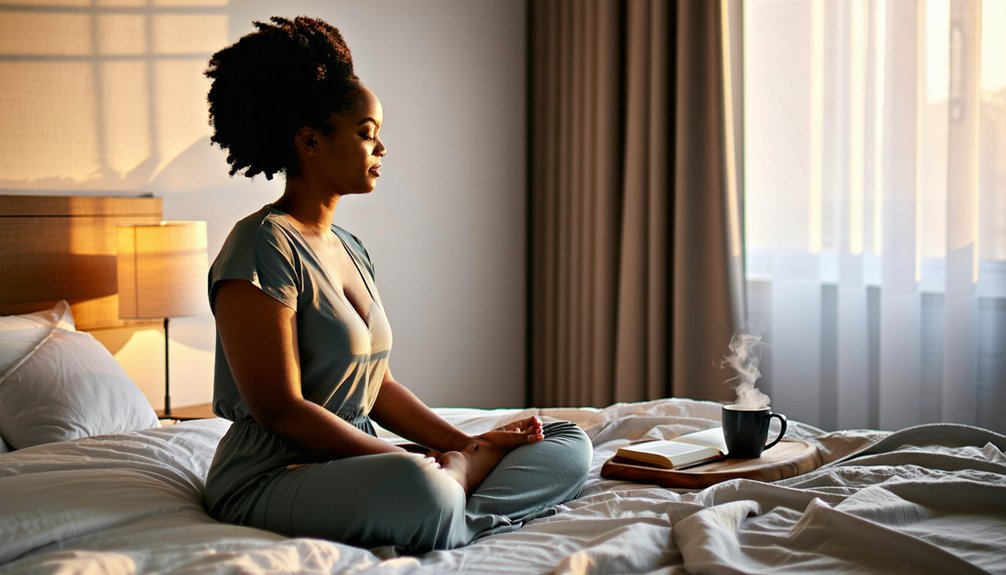
Because your nervous system needs a clear signal to downshift, an ad-hoc “I’m done for the day” won’t cut it—you need a ritual.
Build a workspace ritual you can complete in 10 minutes: sweep your open loops, dump every floating thought onto paper, then circle your top three priorities for tomorrow. Close apps, silence alerts, and step away from your desk.
Anchor it to something you already do—closing your laptop, changing clothes—and pair it with an evening mantra like “Shutdown Complete.” Say it out loud. This tells your body the workday’s over, no more problem-solving required.
If it feels heavy, shrink it. One honest action, repeated daily, beats a perfect ritual you abandon by Friday.
Time-Block Rest Like It’s a Non-Negotiable Meeting
Your shutdown ritual closes the day, but rest still needs a fixed place on the calendar—otherwise it gets bumped by whatever feels urgent. Calendar sanctity means treating rest blocks like doctor visits: unmovable, non-negotiable, protected. Label them “Deep Recharge” or “No Meetings” so priority is unmistakable. Mark your status as “Busy” and let no one book over that time.
Schedule recovery windows before you even add focus blocks—rest is the foundation, not the leftover. Your recharge rituals deserve the same structure you’d give a client call: specific time, specific purpose, zero apology.
This isn’t about finding spare minutes. It’s about claiming space on purpose. When rest lives on your calendar with the same weight as work, guilt loses its grip.
Try These Active Rest Practices for Real Recovery
Rest isn’t one-size-fits-all—it’s a full-body practice with physical, mental, emotional, and spiritual dimensions, each requiring its own approach.
Physically, sway, shake out your hands, or lift your shoulders on an inhale and drop them on exhale. Take nature microdoses—walk barefoot in grass or tend a garden to reconnect and heal.
Mentally, dim the lights, silence notifications, and give your senses a break from overstimulation.
Emotionally, set boundaries, lean on people who replenish you, and let solo moments recharge your social battery.
Spiritually, root your day in intention through prayer, meditation, or apps like Liberate. Weave in breath breaks throughout your day—inhale for four, hold for two, exhale for six—and tell your body, “rest is safe.” Check in before and after. Progress lives in the noticing.
Create a Sanctuary Space for Guilt-Free Rest

Carve out a corner or room that exists for one purpose only: rest.
Block out light with blackout curtains, layer in soft blankets, rugs, and dimmable lighting for sensory layering that grounds your body and quiets your mind. Add noise-canceling devices or white noise machines to seal out the world’s demands.
This space needs sanctuary signage—a physical or verbal cue that tells everyone, including yourself, that judgment and unsolicited advice stay outside. Set a “no apology” policy here: rest isn’t earned, it’s required.
Agree with your household on clear start and end times, and enforce a firm do-not-disturb boundary.
Your sanctuary isn’t decoration. It’s protection. Build it fiercely, use it without guilt, and let it hold you exactly as you are.
Build Community Around Rest and Healing
A sanctuary space protects your solo rest, but healing multiplies when you rest alongside others who understand the weight you carry.
Join the Black Women Resting Cohort for monthly sessions—1st Mondays at 7pm–8:30pm and 3rd Fridays at 9am–10:30pm—to build Peer Circles that hold you accountable to rest instead of hustle. These circles function as living Rest Maps, guiding you toward practices like visualization, gentle movement, and breath work when stillness feels unsafe.
For in-person connection, visit The Brooklyn Wellness Club at 704 Dekalb Avenue.
For virtual support, reach The Black Woman’s Rest Revolution at [email protected].
Mark September 27th for Black Women’s Wellness Day, centered on rest, resilience, and resistance—register at bwwday.org and claim rest as collective liberation.
Rewire the Inner Critic That Ties Worth to Productivity
Before you can rest without guilt, you’ve got to confront the voice that equates your worth with output. That critic isn’t truth—it’s programming. Ask yourself: is this thought absolutely, without a doubt, true? Usually, it isn’t. Give it a goofy name. Shrink it to tiny Comic Sans text in your mind. This is how you challenge narratives that keep you tethered to constant productivity.
Reframe the critic’s demands. Swap “I’m lazy” for “I’m resting, and that’s valid.” End critic statements with “And”—acknowledging imperfection while asserting your right to stop.
Boundary reclamation starts here: rest isn’t earned, it’s owed. Build a Brag Doc proving your worth beyond output. When the critic activates, snap back to the present and ask, “What’s the simplest next step?” Choose rest.
Frequently Asked Questions
How Much Rest Do I Actually Need Each Week to See Benefits?
You need 1-3 rest days weekly, beyond rigid sleep quotas. Your recovery windows depend on fitness level and intensity—beginners need 4-5 days, advanced athletes need 0-3. Trust your body’s signals, not guilt, to guide your rest.
Can Rest Guilt Come Back After I’ve Made Progress Overcoming It?
Yes, it can return—stress and societal triggers resurfacing are normal, not failure. You haven’t lost your progress; you’re human. Lean on maintenance strategies like soft hours and body scans to catch guilt early and reclaim your rest.
What if My Job Doesn’t Allow Flexible Scheduling for Rest Breaks?
You don’t wait for paid leave—you soft-launch micro breaks instead. Schedule a midday walk, a coffee break, a hair appointment. Claim one guilt-free hour daily. Rigid schedules don’t get to dictate your liberation or your right to rest.
Is It Normal to Feel Anxious During Rest Instead of Relaxed?
Yes, it’s normal. Your nervous system’s been conditioned toward hypervigilance, so stillness can trigger anxiety patterns instead of calm. Building rest rituals gradually restores emotional safety, teaching your body that slowing down isn’t dangerous—it’s your liberation practice.
How Do I Explain My Need for Rest to Unsupportive Family Members?
Tell them directly: “I’m exhausted and need rest to stay healthy.” Use short rest scripts, keep answers brief, and skip explanations. Setting boundaries isn’t up for debate—you don’t need their approval to protect your energy.
Conclusion
You don’t need permission to rest. You need practice. Start small: protect one sanctuary space, try one active rest practice, notice one signal your body sends you. Rest isn’t selfish, and it isn’t a reward you earn after burnout—it’s your birthright. Challenge the inner critic that ties your worth to output. Build community that reinforces this truth. Your body has kept score long enough. Choose rest, guilt-free, starting now.
References
- https://www.wellnesstreecounseling.com/post/4-reasons-why-bipoc-women-deserve-rest-without-guilt
- https://www.psychologytoday.com/us/blog/urban-survival/202503/how-to-rest-without-guilt
- https://www.youtube.com/watch?v=A_Cmq-G2IBw
- https://www.youtube.com/watch?v=27BfyH-LCos
- https://www.youtube.com/watch?v=hxzACLYG7nk
- https://www.247liveculture.com/lifestyle/black-girl-day-off-a-day-of-rest-rejuvenation-and-empowerment
- https://www.damemagazine.com/2022/03/02/why-cant-black-women-get-some-rest/
- https://dallasweekly.com/2025/12/why-rest-is-political-for-black-women-during-the-holidays/
- https://www.loveblackgirls.org/post/the-right-to-rest
- https://www.youtube.com/watch?v=IUo2n3qbWUs

