
You don’t need crunches to build real core strength. Planks, side planks, dead bugs, and bird dogs train your transverse abdominis, obliques, and spinal erectors while teaching proper breathing mechanics. Hip bridges add glute and adductor engagement, while anti-rotation moves like Pallof presses and loaded carries challenge stability under real-world conditions. Together, these exercises brace your midsection like a corset instead of just flexing your spine. Below, you’ll find exactly how to put them into practice.
TLDR Key Takeaways
- Crunches overuse rectus abdominis while neglecting transverse abdominis, pelvic floor, and spinal erectors, causing imbalances.
- Planks and side planks brace the entire core—front, sides, and back—without spinal flexion or disc strain.
- Dead bugs and bird dogs train limb movement while maintaining lumbar bracing and anti-extension control.
- Hip bridges and pelvic tilts activate glutes, adductors, and deep core muscles through controlled breathing.
- Anti-rotation moves like Pallof presses and cable rotations strengthen obliques against twisting forces safely.
Why Crunches Aren’t the Best Core Strength Move
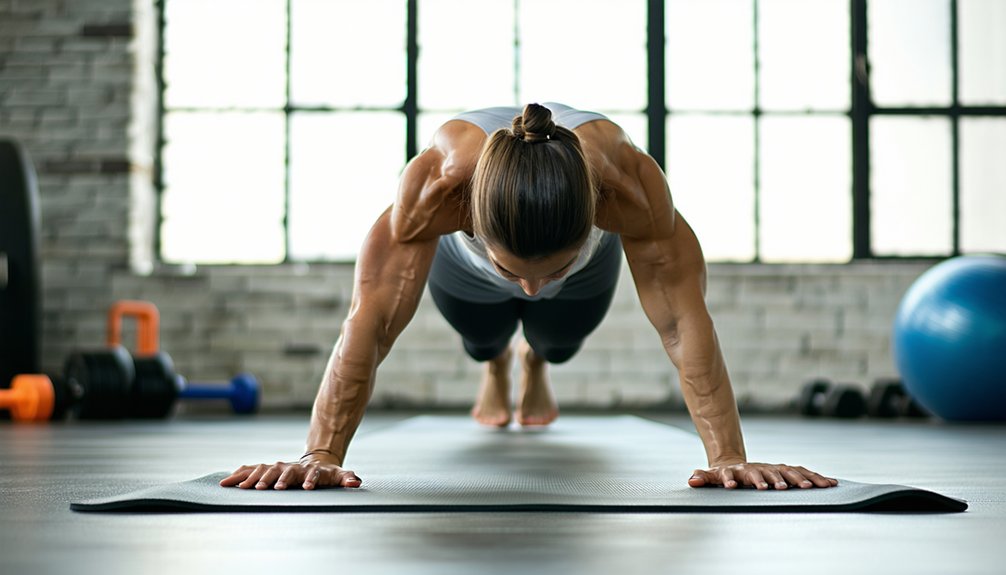
While crunches feel like they’re working your abs, they only scratch the surface—literally. You’re hammering your rectus abdominis while your transverse abdominis, pelvic floor, and spinal erectors sit dormant. That’s not core training—that’s partial training. In fact, this overreliance on one muscle can lead to muscle imbalances and poor posture over time.
Here’s the real cost: repetitive spinal flexion compresses your discs with every rep. Researchers link this flexion-extension cycle directly to disc injury and long-term spinal aging. Your lower back pays the price for your abs’ shortcuts.
Crunches also skip breathing core integration entirely. Real core strength requires your diaphragm and TA working together, not isolated flexion reps disconnected from how you actually breathe and move. Instead, your core should work like a corset, engaging deep stabilizers before any limb movement occurs.
You deserve spine preserving alternatives that build functional strength without the compression damage. A well-rounded routine should instead include rotation, anti-rotation, flexion/extension, lateral, and anti-lateral movements that train your midsection the way it actually functions. Your midsection can get stronger without your spine footing the bill.
Planks: The Foundation for Crunch-Free Core Strength
Planks fix what crunches can’t touch. You’re not isolating one muscle—you’re recruiting your rectus abdominis, transverse abdominis, obliques, and erector spinae all at once. Draw your navel toward your spine and squeeze your abs and glutes to lock in a straight line from head to heels.
Your forearms belong directly beneath your shoulders. This isn’t cosmetic—it’s scapular positioning that protects your joints and keeps tension where it belongs. Add breath control here: steady exhales keep your core braced without letting your hips sag or spike. A weak core is often the hidden culprit behind low back pain, since it fails to properly stabilize your spine.
Start with a 15-second hold. Build toward 30-60 seconds as a beginner, then push for one minute like the experts recommend, working up toward a maximum hold of two minutes as your strength improves. Modify with knees down if you need to—your core still works. Once you’ve mastered the basics, try side-plank variations to target your obliques and address any unilateral strength imbalances.
Side Planks for Oblique and Hip Stability
Once you’ve perfected the front plank, side planks target what that move can’t reach: your obliques and hip stabilizers. Stack your feet or stagger them for balance, then stack your elbow directly under your shoulder—scapular control here keeps your shoulder girdle stable and protects you from strain. Press your forearm flat, brace your core, and lift your hips until your body forms one straight line from ankles to head. Don’t let your hips sag or rotate; that’s where oblique activation gets lost. Proper alignment also calls on the transverse abdominis, which acts like a deep stabilizing belt around your waist.
This is isometric endurance training: hold 15-30 seconds if you’re starting out, working toward 60. Beginners can drop to their knees. Everyone else can progress toward lifting the top arm and leg for an anti-rotation challenge that builds real spinal resilience. Pressing your feet firmly into the floor also increases gluteus medius engagement, which helps take stress off the shoulder joint. Beyond strength gains, this exercise can also help reduce musculoskeletal pain and prevent it from recurring.
Dead Bugs and Bird Dogs for Deep Core Activation
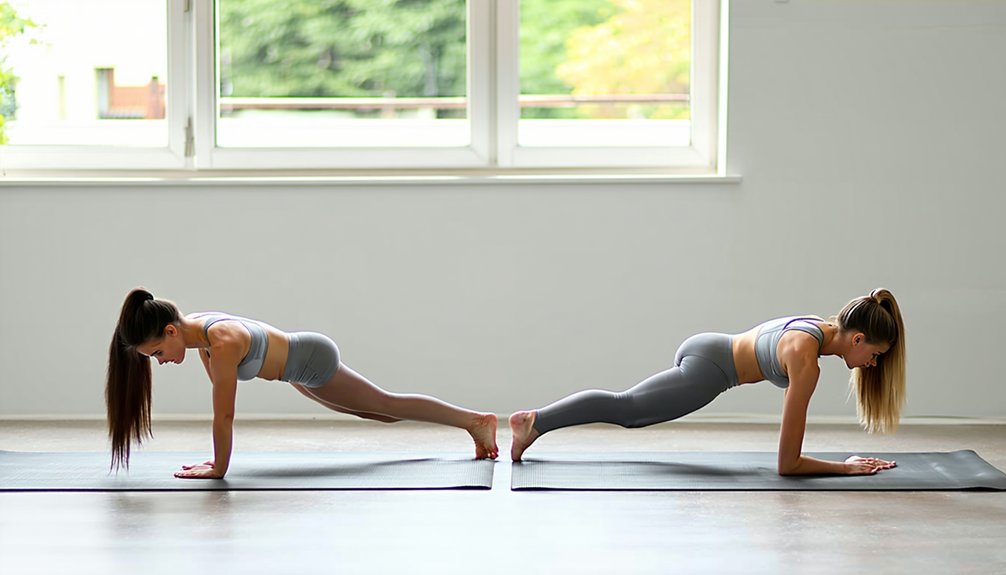
Building deep core strength doesn’t require crunching your spine—it requires learning to resist movement while your limbs move independently, and that’s exactly what dead bugs train.
Press your lower back into the floor to lock in lumbar bracing, then lower one arm and the opposite leg together, hovering just above the ground.
Breath timing matters here: exhale slowly through the lowering phase instead of holding your breath, which lets your TVA do the work instead of internal pressure.
Perfect arm-only reps for a week or two before adding legs. Aim to do this exercise three to four times a week for the best results. With consistent daily practice, you can expect structural lower back pain reduction within 6 to 8 weeks.
Add dumbbells, ankle weights, or a ball between your knees once you’ve nailed the pattern. Research shows the dead bug produces high transversus abdominis activation, even outperforming some Pilates trunk exercises.
This isn’t about crunching harder—it’s about training your core to stay silent while everything else moves.
Hip Bridges for Core, Glute, and Adductor Strength
Squeezing your knees together might be the single easiest upgrade you can make to a basic bridge. Adding hip adduction fires up your rectus abdominis, obliques, and glutes more than a standard bridge alone—research confirms it. Place a foam roller, yoga block, or pillow between your knees to enhance adductor activation and target your pelvic floor simultaneously.
Lie back, knees bent, feet hip-width apart. Take a belly breath, brace your core, then lift your hips while squeezing the object between your legs. Keep your spine neutral—shoulders, hips, and knees should form a straight line at the top. Drive through your heels, not your toes. A study of fourteen healthy women found this variation significantly boosted glute activation compared to a traditional bridge.
Start with 2–4 sets of 15–35 reps. Your inner thighs and lower back will thank you. For an easier progression, you can also press through your heels with toes lifted off the ground to emphasize the posterior chain.
Pelvic Tilts and Belt Resistance for Core Engagement
If bridges fire up your glutes, pelvic tilts zero in on the deep core muscles that stabilize your spine.
Start by flattening your lower back into the mat, contracting your abs and tucking your tailbone under. Then arch gently into anterior tilt, relaxing your abs for a light stretch. Alternate between the two for 10 to 15 reps, holding each posterior tilt for a few seconds to maximize engagement.
Loop a resistance band or belt around your thighs to level up. Banded tilts force your hips to stay stable against outward pull, deepening core bracing and building glute strength simultaneously. This resistance sharpens pelvic awareness, teaching you controlled, smooth movement instead of jerky reps. This deep core work directly engages the transverse abdominis, the deepest abdominal layer that wraps between the ribs and pelvis for stability.
Progress by lifting one foot, or try all-fours for an added challenge.
Leg-Focused Moves That Build Core Strength Without Crunches
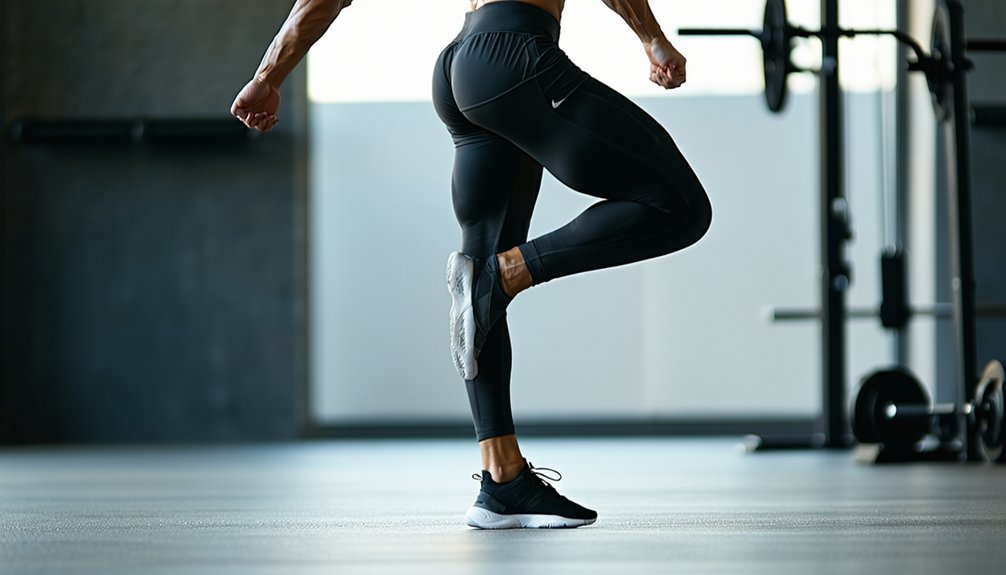
Since your legs connect directly to your core through the hip flexors and deep stabilizers, using them as resistance turns everyday moves into serious ab work.
Mountain climbers demand you pull your belly button toward your spine while alternating legs, forcing your midsection to stabilize against motion.
Hanging knee raises and leg lifts press your lower back into the mat, teaching breathing mechanics through controlled exhales as you lift.
Standing leg raises challenge ankle stability while your core keeps you upright on one leg.
Scissor kicks and flutter kicks brace your abs tight, hovering legs just above the floor without losing tension.
Supersets pairing lunges, deadlifts, and squats with glute bridges build strength through movement—no crunching required.
Your legs do the work; your core holds the line.
Rotational Exercises for a Stronger, Twist-Ready Core
Your legs aren’t the only body part that can build a bulletproof core—rotation does something straight-line moves can’t: it trains your obliques, transverse abdominis, and spinal erectors to control twisting forces instead of just resisting linear ones.
Twist from your thoracic spine, not your lower back—that’s where thoracic mobility comes in, letting your trunk rotate while your hips stay locked forward.
Try Dead Bugs, Thread the Needle planks, or cable rotations pulling hip-to-hip with straight arms. Add dumbbell swings and medicine ball slams for explosive power. Pallof press holds build serious anti rotational endurance—aim for twenty to sixty seconds per set.
Train rotation two to three times weekly, running eight to fifteen reps per side. Progress from static holds to kinetic throws, and you’ll own every twist your body makes.
Choosing the Right Twisting Move for Your Core Goals
How do you know which twist actually fits your goal? Start with intent, not variety.
If you want oblique dominance, choose the Oblique Twist Reach or Knee Punch Twist—both isolate lateral rotation with precision.
Want full midsection integration? The Lunge Rotation or Medicine Ball Lunge Twist recruit legs, hips, and core together.
Anti-rotational work like the Band Rotation or Anti-Rotation Hold builds the bracing strength that protects your spine during real-world twisting.
Whatever you choose, respect breath mechanics—exhale through the rotation, don’t hold tension in your neck.
Then apply progressive loading: heavier plates, longer bands, or slower tempo as control improves.
Match the move to the goal, and your core stops guessing and starts building real, functional strength.
Standing Core Workouts With Kettlebells and Dumbbells

Once you add a kettlebell or dumbbell to standing core work, the game changes: stability now has to fight an external load instead of just bodyweight.
Unilateral loading forces your spine to stabilize against uneven pull, so keep hips square and core braced during drags, marches, and rows.
Single leg stability comes into play with single-leg deadlifts, demanding control from one limb while the other stays engaged.
Weighted carries—like suitcase deadlifts with cleans and marches—challenge anti-lateral flexion, keeping you upright instead of leaning toward the load.
Kettlebell moves like halos, windmills, and front rack squats build rotational control and tension under vertical load.
Switch sides every round: balanced training means both sides of your midsection earn equal strength and freedom of movement.
Dumbbell Crawls and Chest Explosions for Full-Body Core Work
Crawling on all fours turns a simple floor drill into a full-body core challenge that rivals any standing exercise. The weighted bearcrawl demands you set hands on dumbbells, lift knees an inch off the floor, and move opposing limbs—right hand, left foot—together. Your core fights rotation the entire time, while shoulders, glutes, and hamstrings stay switched on. Start light, attain 40 to 50 lb dumbbells, then crawl forward 10 feet before reversing; backward steps hit differently since you’ve got less mechanical advantage.
For explosive variety, try a chest explosion from push-up position: drive off the ground with power, reset, and repeat. This builds the same anti-rotation strength as crawling but trains speed and control simultaneously. Together, these moves free you from crunches while forging real, functional core power.
How to Build a Weekly Core Routine Without Crunches
Regarding consistency, you’ll get the best results training your core 2–3 times per week, either as a standalone session or tacked onto strength days. Give yourself one rest day between sessions—recovery monitoring matters here, since fatigue kills form and stalls progress.
For session planning, pick 3–4 exercises covering all four pillars: anti-extension, anti-rotation, anti-lateral flexion, and stabilization. Structure your workout as a circuit: 3 rounds, 30–60 seconds rest between moves, 1–2 minutes between rounds.
Warm up with air squats, lunges, pushups, and bear crawls for 30 seconds each.
Then hit 6 core moves back-to-back, no rest, prioritizing tension over reps. Pair core days with lower-body or full-body training to build real functional strength—no wasted sessions, no burnout, just steady freedom through smart programming.
Frequently Asked Questions
How Long Should I Rest Between Core Exercises During a Workout?
You’ll want 30–60s between core exercises for most goals. Use active recovery—shift positions or breathe deeply—instead of full stops. This keeps your midsection engaged, builds endurance, and frees you from rigid, overly long breaks.
Can These Exercises Help Reduce Lower Back Pain Over Time?
Yes—you’ll build lasting relief by combining anti-rotation core work with posture education and breath mechanics. You’re training your spine to brace naturally, freeing you from chronic strain and giving you real, sustainable control over your body’s movement.
How Soon Will I Notice Visible Core Strength Improvements?
You’ll notice strength progress markers within 2-4 weeks—better posture, less pain, longer plank holds. Visible definition takes 3+ months, and diet impact matters most: low body fat reveals muscle you’ve already built. Stay consistent!
Are These Exercises Safe to Do During Pregnancy?
Yes, with pregnancy modifications: skip crunches and back-lying moves after your first trimester. Try side-lying leg lifts, standing squats, or glute bridges instead. Engage your pelvic floor by squeezing gently while breathing normally—you’ll stay strong, safe, and enabled.
What Warm-Up Should I Do Before Starting a Core Routine?
Spend at least 6 minutes on active stretches like Star Jacks, Side Reaches, and Cat x Cow to enhance blood flow and mobility. Pair each movement with diaphragmatic breathing—you’ll engage your core fully and move freely into your routine.
Conclusion
You don’t need crunches to build a strong, functional core. Planks, dead bugs, bird dogs, and standing kettlebell work train your midsection to stabilize your spine and transfer power—exactly what your core’s designed to do. Mix these moves into 2-3 sessions weekly, progressing intensity as you get stronger. Your core will handle real-world demands better, and you’ll skip the neck strain and diminishing returns that crunches often bring.
References
- https://www.womenshealthmag.com/uk/fitness/strength-training/g33012059/15-no-crunch-core-exercises/
- https://www.aarp.org/videos/health/fitness/6020364238001/
- https://teamrwb.org/functional-fitness/3-core-exercises-that-arent-sit-ups
- https://www.youtube.com/watch?v=826AbiI7sS4
- https://www.youtube.com/watch?v=4jIKswM6p5Y
- https://www.cnn.com/2024/03/28/health/core-strengthening-without-planks-wellness
- https://www.menshealth.com/uk/building-muscle/a30713438/abs-workout-without-crunches/
- https://www.uhhospitals.org/blog/articles/2015/02/4-ab-exercises-that-work-better-than-crunches
- https://www.youtube.com/watch?v=P2bOugnH2T4
- https://pivotalmotion.physio/the-core-strength-lie/

