
Your stroke symptoms may look nothing like a man’s. You’ll share classic signs—face drooping, arm weakness, slurred speech—but you’re also more likely to experience subtle red flags: sudden fatigue, confusion, nausea, or even persistent hiccups signaling a brainstem stroke. These atypical symptoms cause dangerous delays, and women face higher stroke mortality as a result. Use BE FAST to catch warning signs immediately. Keep going to uncover exactly which overlooked symptoms demand your attention—and why every minute matters.
TLDR Key Takeaways
- Use BE FAST—Balance, Eyes, Face, Arm, Speech, Time—to catch stroke signs early and note symptom onset.
- Watch for atypical signs in women: sudden fatigue, confusion, fainting, or unexplained shortness of breath.
- Persistent hiccups with numbness, dizziness, or confusion may signal a brainstem stroke needing urgent care.
- Nausea, vertigo, and balance loss often indicate posterior circulation strokes, more common in women.
- Call 911 immediately—every minute untreated destroys about 1.9 million neurons, reducing treatment options.
What Stroke Symptoms Do Women Share With Men?

Often overlooked, the truth is that women and men share most core stroke symptoms. You’ll notice sudden weakness, numbness, or paralysis on one side of your body—face, arm, or leg.
Facial drooping and arm weakness signal trouble, especially when you can’t lift both arms evenly.
Motor symmetry backs this up: research shows 56% of women and 56% of men experience motor deficits. Speech deficits track closely too, hitting 41% of women and 40% of men.
Vision changes don’t discriminate either. You might face blurred vision, double vision, or sudden vision loss in one or both eyes.
Dizziness, vertigo, and balance problems strike both sexes equally. A sudden severe headache with no known cause is also one of the signs of stroke shared across genders. Following the traditional FAST guidelines—face drooping, arm weakness, speech difficulty, and time to call 911—remains critical for both men and women.
Confusion and slurred speech demand the same urgency, regardless of your gender. Notably, stroke remains a leading cause of death and disability worldwide, ranking as the second leading cause of death globally in 2019.
The Subtle Stroke Symptoms Women Often Miss
While men typically report classic stroke warning signs, you’re 33% less likely to name one as your chief complaint—your body may be sending a different signal entirely.
Fatigue That Won’t Quit
Overwhelming exhaustion, unrelieved by rest, counts as a legitimate subtle biomarker—not stress.
Cognitive Shifts You Can’t Ignore
Sudden confusion, word-finding trouble, or brain fog signals atypical presentations worth immediate attention.
Breathing and Heart Changes
If you’re over 55, shortness of breath makes up 58% of women’s non-conventional complaints. Women actually account for 60% of all stroke-related deaths in the U.S., making these atypical cardiac and respiratory signs especially critical to recognize.
Consciousness and Balance Red Flags
Fainting, seizures, or unexplained falls account for 60% of unusual symptoms reported. Even if these symptoms resolve on their own, you should still call 911 for urgent evaluation.
Trust Your Body
You know your baseline. Don’t let anyone—including yourself—dismiss what feels wrong. The most telling clue is sudden onset—when symptoms appear abruptly rather than gradually, that timing alone should prompt immediate evaluation.
Why Hiccups Can Actually Signal a Stroke
Because your brainstem houses the hiccup reflex arc, a stroke in this region can trigger uncontrollable, persistent hiccups that won’t respond to your usual remedies—holding your breath, sipping water, or getting startled. These brainstem mechanisms control far more than digestion; they’re wired directly into your survival systems.
Here’s what makes this critical for you: posterior circulation strokes—the ones disrupting the hiccup reflex—strike women more often than men. That means hiccups deserve your attention as a potential stroke sign, not a footnote. Most hiccups are harmless and resolve within 48 hours, but persistence beyond that window is what changes the picture.
You don’t need every symptom to act. Persistent hiccups lasting over 48 hours, paired with numbness, confusion, or dizziness, mean it’s time to call 911. This urgency holds even if the hiccups are the only sign present, since brainstem strokes can suppress other typical warning symptoms. If treated quickly, clot-busting drugs can be given within 4.5 hours of symptom onset to help limit lasting damage. Trust your body. You know when something feels wrong—don’t wait for permission to seek help.
Nausea and Chest Pain: Stroke Symptoms in Disguise

Hiccups rarely travel alone. They often bring nausea, vomiting, or dizziness—especially when a stroke hits the back of your brain, where balance and coordination live. Don’t dismiss this as a stomach bug. That’s gastrointestinal misattribution, and it costs precious time you don’t have. Sudden trouble walking or loss of balance can also accompany these symptoms, signaling a stroke rather than a minor stomach issue.
Chest pain complicates things further. You might mistake it for atypical cardiac pain, a heart attack mimicking stroke symptoms. Both conditions share overlapping signs: nausea, chest discomfort, shortness of breath, palpitations. Your body isn’t confused—medical assessment might be. Fatigue may also show up alongside these symptoms, and fatigue is often noted as a stroke sign specifically in women.
Here’s your freedom move: skip the guesswork. Call 911 immediately for sudden nausea or chest pain. Don’t drive yourself. Don’t wait to “see if it passes.” Every minute matters—act fast, get evaluated, protect your brain. Delaying care matters greatly, since heart muscle can be irreversibly damaged after about 20 minutes of blood loss.
Why Confusion and Brain Fog Aren’t Just Stress
When your brain suddenly can’t process a simple conversation, that’s not overwork talking—it’s oxygen-deprived tissue signaling distress. You deserve to trust your body’s alarms, not dismiss them.
Sudden vs. Gradual
Stress builds slowly. Sudden disorientation doesn’t. If you can’t follow instructions or understand speech out of nowhere, that’s your cue to call 911—not push through with coffee.
The Silent Threat
Silent cognitive decline hides behind “normal” fatigue. Brain fog from reduced blood flow mimics tiredness, but it’s your nervous system flagging small-scale damage before it escalates. During an untreated stroke, roughly 1.9 million brain cells are lost every minute, which is why hesitating to act can make recovery far harder. In fact, research estimates that 8 to 10 million Americans experience silent brain infarcts each year, often without realizing it.
Trust Your Clarity
You know your baseline. When confusion feels foreign, severe, or paired with personality shifts, that’s neurological—not stress. This kind of confusion often exists alongside other cognitive difficulties, including problems with attention, memory, and planning. Act fast. Your independence depends on it.
Why Sudden Fatigue Deserves Immediate Attention
If exhaustion hits you out of nowhere with no physical cause, don’t chalk it up to a rough week—your brain cells might already be starving for oxygen. This isn’t ordinary tiredness. It’s your brain metabolism breaking down as blood flow gets cut off, leaving cells without the fuel they need to function.
You don’t need one-sided weakness to be in danger. Fatigue alone, paired with nausea, dizziness, racing heartbeat, or shortness of breath, signals a medical emergency. Don’t dismiss it as stress—that delay costs brain tissue.
Trust your body. Emergency recognition means treating unexplained exhaustion as seriously as any other stroke symptom. Call 911 immediately. Time lost is brain lost, and fast action is how you reclaim control over your outcome.
How Deadly Is Stroke for Women, Really?

The numbers don’t lie: stroke kills women at a rate that should alarm every woman past 55. You’re facing 60% of all stroke deaths in the US, and stroke ranks as the third leading cause of death for women—versus fifth for men. That’s not a rounding error; that’s a sex differences gap you deserve to know about.
Roughly 55,000 more women die from stroke annually than men, and this excess is growing. Postmenopausal risks compound the danger: after age 75-85, your stroke incidence climbs sharply, and past 85, you face a 15% higher mortality rate than men your age.
Case fatality studies back this up—26 of 31 show women dying more often within 30 days post-stroke. Knowledge is power. Use it.
Does Birth Control Raise Stroke Risk After 35?
Turning 35 doesn’t automatically make your birth control dangerous—but combine that age with smoking, and you’ve created a serious problem. This age interaction is critical: smokers over 35 face markedly increased stroke risk with combined pills, especially at 10+ cigarettes daily. Add hypertension, and susceptibility climbs further.
Without these risk factors, though, women over 35 show no increased stroke risk with current formulations.
Formulation differences matter too. Third and fourth-generation progestin pills carry the highest risk—34 additional ischemic strokes per 100,000 person-years. Non-oral options aren’t safer: the vaginal ring raises risk 2.4-fold, while patches raise it 3.4-fold.
Progestin-only pills, implants, and IUDs? They don’t carry this increased risk, giving you real choices that fit your body and your freedom.
Are Blood Pressure and Diabetes Raising Your Stroke Risk?
Blood pressure quietly drives your stroke risk higher than almost any other factor—and it hits women harder than men. Every 10-mm Hg rise in systolic pressure increases your stroke risk by 38%. Your risk climbs almost twice as fast as men’s, so home monitoring isn’t optional—it’s power. Track anything above 120/80 and report it.
Diabetes compounds this danger, raising stroke risk 2-6 times on its own. When high blood pressure and diabetes collide, arterial damage accelerates fast.
You control the outcome through medication adherence and daily choices. Cut salt, add fiber-rich whole grains, move your body, and take prescribed medicines consistently. Intensive blood pressure control alone cuts stroke risk 41% in people with diabetes—your action changes your odds.
How Atrial Fibrillation Triples Your Stroke Risk
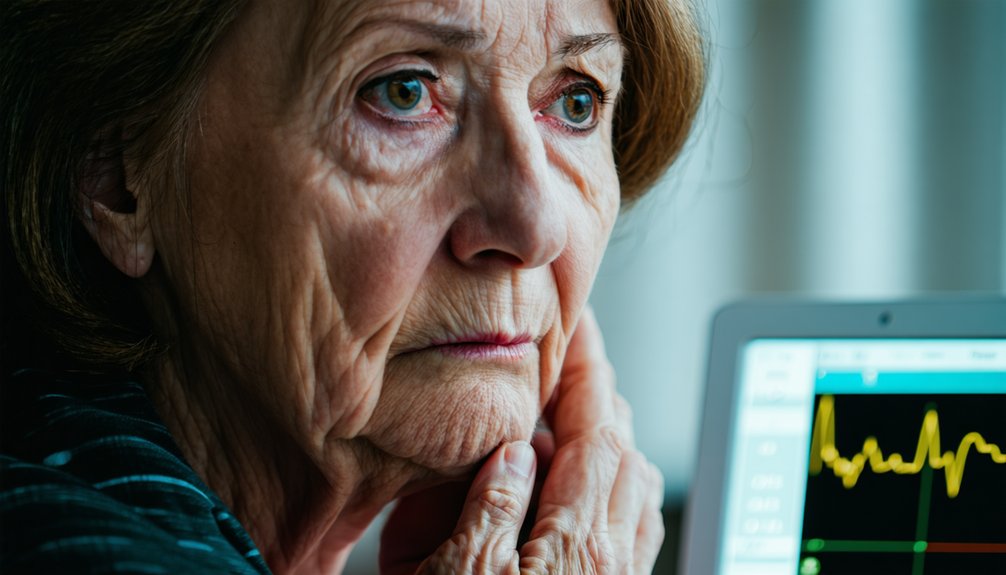
When your heart quivers instead of beating in rhythm, blood pools in your left atrial appendage and forms clots that can travel straight to your brain. This thrombus formation is why AF drives roughly 20% of all ischemic strokes and raises your overall stroke risk five-fold compared to people without the condition.
Your risk isn’t fixed. It climbs with your AF burden—the longer episodes last, the higher your hazard, with each additional hour raising risk measurably.
Left atrial enlargement compounds the danger further, especially for embolic strokes.
Know this: AF-related strokes tend to hit harder, causing more severe damage and higher mortality than strokes without it. Understanding your rhythm gives you power to act early.
Use BE FAST to Catch Stroke Symptoms Early
Rarely does stroke give you a second chance to recognize its signs, so BE FAST gives you a quick mental checklist when seconds count.
Balance: Watch for sudden loss of coordination, dizziness, or trouble walking.
Eyes: Blurred vision, double vision, or sudden sight loss in one or both eyes signals trouble.
Face: Check for drooping or an uneven smile.
Arm: Test for weakness—does one arm drift downward when raised?
Speech: Have the person repeat “The sky is blue.” Slurred or garbled words demand attention.
Time: Note when symptoms started, then trigger emergency activation immediately.
Early recognition is your power move—don’t wait, don’t second-guess. Call 911 the moment BE FAST symptoms appear.
Why Every Minute Counts After Stroke Symptoms Start
Image your brain losing 1.9 million neurons every single minute a stroke goes untreated—that’s the reality of ischemic stroke.
When a clot blocks blood flow, your brain metabolism crashes fast, starving cells of oxygen and glucose they need to survive.
Your collateral circulation—backup vessels rerouting blood—buys you limited time, but it can’t hold off damage forever.
You’ve got a narrow window to act. Clot-busting tPA works best within three hours, up to 4.5 in select cases, yet hospitals average a 76-minute delay before treatment starts. That’s precious time you can’t get back.
Don’t wait to see if symptoms pass. Call 911 immediately. EMS can alert stroke teams before you even reach the hospital, cutting delays and protecting your independence, your speech, and your future.
Frequently Asked Questions
Can Stroke Symptoms in Women Appear During Pregnancy or Postpartum?
Yes—you can face pregnancy stroke warning signs during your third trimester or after birth. Stay free through postpartum vigilance: watch for severe headaches, weakness, or confusion. Trust your body, act fast, reclaim your health boldly.
Are Younger Women at Risk for Stroke, or Just Older Women?
You’re not immune just because you’re young—stroke risk hits young adults hard, especially contraceptive users. If you’re under 35, you actually face higher odds than men your age. Know your risk; own your health.
Can Stress or Anxiety Alone Trigger Stroke-Like Symptoms in Women?
Yes—anxiety can fake you out. Panic attacks and hyperventilation syndrome trigger numbness, dizziness, and racing thoughts that mimic stroke. You’ll notice symptoms build gradually, unlike a stroke’s sudden onset. Trust your body, but verify with a doctor.
Should Women With Migraines Worry About Increased Stroke Risk?
Yes, especially with aura—but you’re not powerless. Prioritize migraine management, quit smoking, reconsider oral contraceptives, and adopt lifestyle modifications. You control more risk factors than you think. Knowledge frees you to act, not fear.
Can Hormone Replacement Therapy Affect Stroke Risk in Women?
Yes—oral estrogen therapy raises your clot risk and stroke odds by up to 35%. You’re not powerless, though: choose transdermal patches or gels instead. They won’t spike your clot risk like pills do.
Conclusion
You know your body best, so don’t ignore what feels off. If you notice sudden hiccups, nausea, confusion, or chest pain alongside classic warning signs, act fast—remember BE FAST and call emergency services immediately. Managing blood pressure, diabetes, and atrial fibrillation lowers your risk, but recognizing symptoms early saves brain cells and lives. Every minute matters, so trust your instincts and get help right away. Your quick action can make all the difference.
References
- https://www.stroke.org/en/about-stroke/stroke-symptoms
- https://www.nm.org/conditions-and-care-areas/neurosciences/comprehensive-stroke-centers/before-stroke/symptoms-in-women
- https://www.mayoclinic.org/diseases-conditions/stroke/symptoms-causes/syc-20350113
- https://nortonhealthcare.com/news/warning-signs-of-a-stroke-in-a-woman/
- https://www.youtube.com/watch?v=P8mCVJmO3mE
- https://blog.swedish.org/swedish-blog/know-how-to-recognize-subtle-signs-of-stroke-in-women
- https://www.hackensackmeridianhealth.org/en/healthier-you/2026/05/28/stroke-symptoms-in-women-signs-you-shouldnt-ignore
- https://womenshealth.gov/heart-disease-and-stroke/stroke/stroke-and-women
- https://www.nm.org/healthbeat/healthy-tips/differences-in-stroke-symptoms-between-women-and-men
- https://www.heart.org/en/news/2024/05/22/7-things-to-know-about-how-stroke-is-different-for-women

