
Get outside within 30–60 minutes of waking—this is when your eyes’ ipRGCs signal your SCN to suppress melatonin and spike cortisol, setting your entire circadian rhythm. Aim for 5–10 minutes on bright days, 15–20 when it’s overcast. This daily habit shifts your sleep midpoint earlier, sharpens alertness, and improves sleep efficiency. Consistency matters more than perfect timing. Keep going below to see exactly how to build this into your morning.
TLDR Key Takeaways
- Get outside within 30–60 minutes of waking to trigger peak circadian-shifting sensitivity.
- Aim for 5–10 minutes on sunny days, 15–20 on overcast days, or 20–30 minutes in winter.
- Morning light suppresses melatonin and primes a cortisol spike, boosting alertness within 30–60 minutes.
- Face the sun without sunglasses or blue-blockers to let light reach circadian-sensitive retinal cells.
- Consistent daily morning exposure improves sleep efficiency, reduces fragmentation, and advances sleep onset timing.
Why Morning Light Controls Your Sleep Cycle
Wake up, step outside, and you’re doing more than just soaking in sunshine—you’re resetting your internal clock. Morning light hits your retinal photoreceptors, triggering circadian entrainment that shifts your sleep timing earlier. Every 30 minutes of sun before 10 a.m. cuts your sleep midpoint by 23 minutes. Light within an hour of waking can shift your circadian system a full hour earlier per day.
This isn’t passive exposure—it’s active control over your biology. Your body responds to morning light by suppressing melatonin, building the sleep pressure you need for nightfall. Five days of consistent morning bright light produces earlier sleep onset than baseline. Morning light exposure also increases cortisol production, promoting daytime alertness. Getting bright light shortly after waking may also increase morning alertness itself, reinforcing the benefits of an early start. You’re not at the mercy of poor sleep; you’re wielding a tool that rewires your rhythm, one sunrise at a time.
How Sunlight Resets Your Body Clock
Your eyes act as the trigger for this entire process. Specialized retinal pathways detect sunlight and send signals directly to your suprachiasmatic nucleus, bypassing visual processing entirely.
This isn’t passive—it’s a direct command line to your brain’s primary clock. The moment light hits your retina, your SCN suppresses melatonin and primes your cortisol spike, waking your body up within 30 to 60 minutes.
This system works regardless of your genetic chronotype. Whether you’re naturally an early riser or a night owl, the retinohypothalamic tract responds to the same signal. This master clock also coordinates other rhythms throughout the body by influencing cortisol through the HPA axis and melatonin through the pineal gland.
You’re not fighting your biology—you’re working with hardwired circuitry. Understanding this mechanism gives you control: expose your eyes to real sunlight, and you reset your internal timing on your own terms. If outdoor sunlight isn’t accessible, bright light therapy lamps can serve as an effective substitute for this morning reset. Getting this exposure right in the morning also determines the timing of melatonin onset later that night.
The Best Time to Get Morning Sunlight
Knowing that your retinohypothalamic tract fires on cue doesn’t help much if you get the timing wrong.
Your window is the first 30 to 60 minutes after waking, when light sensitivity peaks and the circadian alerting mechanism strengthens fastest. Sunrise rituals work because proximity to actual sunrise amplifies the effect—shadows longer than your body signal the infrared-rich light you want.
Sunny mornings need just 5 to 10 minutes; cloudy days call for 15 to 20.
In winter or northern latitudes, shift your exposure to 10 AM–2 PM instead. No direct sun at wake-up? Smart window placement near where you sit each morning, or a light therapy box, can substitute. Leaving your sunglasses at home during this window can also help, since they can block light from reaching the light-sensitive cells in your eyes.
Consistency matters more than perfection—claim your morning light daily, and your sleep midpoint shifts with it. This same daily consistency also helps promote a properly timed evening melatonin rise.
How Long Should You Spend in Morning Light?
Rarely does the answer boil down to one magic number—it depends on the sky. On bright mornings, 5 to 10 minutes anchors your body clock.
Cloudy days demand more—stretch to 15 or 20 minutes to match that intensity. Winter mornings? Push toward 20 to 30 minutes.
If you want sleep-optimizing benefits, research points higher: 30 minutes delivers solid results, while some studies flag 1.5 to 2 hours as the real breakthrough for alertness and rest.
Individual variability matters here—your ideal duration depends on your baseline sensitivity, your location, and the season. Start small on sunny days, then build through habit formation. Consistency beats chasing a perfect number. Face the sun, skip the sunglasses, and let your routine evolve naturally over time. Keep in mind that natural sunlight is far more intense than typical indoor lighting, with outdoor light reaching roughly 100,000 lux compared to much dimmer artificial sources. Remember that window glass blocks the key wavelengths needed for effect, so this exposure must happen outside.
How Regular Morning Sun Shifts Your Sleep Midpoint
Numbers tell the story better than intuition here. Every extra 30 minutes of morning sunlight you get before 10:00 AM pulls your sleep midpoint about 23 minutes earlier—a finding backed with strong statistical confidence. This isn’t guesswork; it’s your circadian phase responding directly to light timing. Afternoon or evening sun won’t do this work for you—the effect belongs to the morning window alone. Interestingly, even after 3 p.m. sunlight can shift your midpoint earlier too, but the morning effect is stronger.
You don’t need perfect timing every day. What matters more is habit formation: getting outside consistently, even if the exact minute shifts slightly. Your body clock responds to patterns, not one-off efforts. Fall asleep and wake up earlier by making morning light a repeated cue, not a rare event. Freedom from erratic sleep starts with this simple, repeatable habit.
Morning Light and Sleep Efficiency: What the Research Shows
Regarding hard data, morning bright light delivers measurable gains: sleep efficiency climbs to 83.82%, compared to 80.35% under regular office lighting.
Your fragmentation index drops too—15.26% versus 17.18%—meaning fewer disruptive awakenings and deeper rest.
You’ll also spend less time in bed while getting more out of it: 7.12 hours versus 7.51, proof that quality trumps quantity.
Light timing matters more than intensity alone. Get outside before 10 a.m., and you’ll shift your sleep onset earlier without forcing it. This intervention involved just 1.5 hours of morning bright light exposure over five workdays to produce these effects.
The mechanism ties directly to melatonin suppression during dark hours—morning exposure resets your internal clock, advancing your body’s natural signal to wind down at night. This happens because specialized ipRGCs in the retina detect short-wavelength light and relay timing signals to your circadian system.
The data’s clear: consistent morning light exposure hands you real control over your sleep design.
How Morning Sunlight Boosts Mood and Alertness
Beyond resetting your sleep clock, morning light does something just as powerful for your brain chemistry. Sunlight triggers serotonin release, the hormone that keeps you calm, focused, and positive. People with greater daytime light exposure report higher happiness odds (OR: 1.41–1.48) and lower rates of depression.
At the same time, morning light shuts down melatonin production, sharpening alertness within 30–60 minutes of waking. This translates directly into workplace productivity—better concentration, sustained energy, and reduced fatigue throughout the day. It also strengthens your capacity for social connection, since stable mood and steady energy make you more present with others. Reduced sunlight exposure has even been linked to seasonal-pattern depression, underscoring how vital daily light is to emotional health.
Just 20–30 minutes outside before noon can free you from sluggishness and give you real command over your day. This same daily practice also supports circadian rhythm regulation by signaling the brain to suppress melatonin during daylight hours. Morning sunlight exposure between 8 a.m. and noon has also been associated with weight maintenance and fat reduction, adding a physical benefit to its mental health rewards.
Signs Your Sleep Quality Is Improving
Once your body clock starts syncing with natural light, your sleep framework shifts in measurable ways. You’ll fall asleep within 30 minutes of lying down, and you’ll stay asleep for at least 85% of your time in bed. If you wake during the night, you’ll drift back off within 20 minutes—awakenings themselves become rare, brief, and forgettable.
These sleep milestones aren’t just numbers; they translate into real freedom during your waking hours. Fatigue fades, energy stays steady, and grogginess gives way to genuine morning alertness. Your mood stabilizes, irritability drops, and mental clarity sharpens.
Consistent bedtime rituals reinforce this progress, deepening restorative sleep and enhancing REM activity. The result: you wake up rested, clear-headed, and finally in control of your own rhythm.
Simple Ways to Get More Morning Light Daily
Reaching those sleep milestones starts with what you do the moment you wake up. Get outside within 30 to 60 minutes of rising—5 to 10 minutes on bright days, 15 to 20 on overcast ones. Skip the sunglasses. Open your blinds immediately, then take your coffee to the porch. Porch breakfasts and stretching outdoors turn passive habits into circadian resets.
Free yourself from the car when you can: commute walking or biking builds light exposure into your day without extra effort. Indoors, face your desk toward the window, swap heavy curtains for sheer ones, and add a mirror to bounce light deeper into the room. No sun yet? Flip on bright lights or try a 10,000-lux therapy lamp. Aim for an hour outside daily.
Using a Light Therapy Lamp When Sunlight Isn’t Available
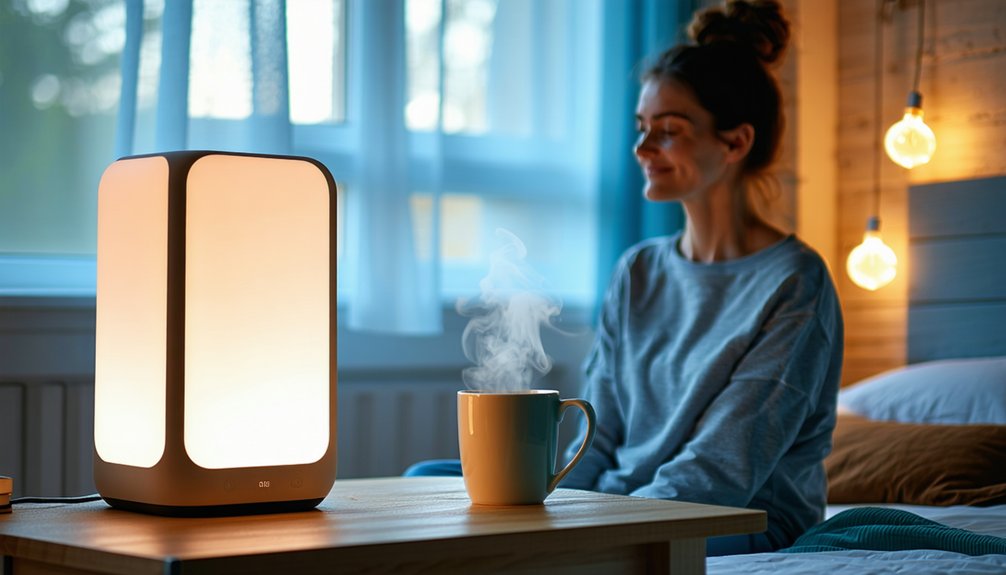
When mornings stay dark or gray, a light therapy lamp steps in as your stand-in sun. Your brain reads its bright output as sunlight, suppressing melatonin and signaling time to wake.
Choose a lamp providing at least 1,000 lux—strong intensity means just 20 minutes of exposure works, while weaker units demand up to two hours. Sit 16 to 24 inches away, never looking directly at the bulb. Use it right after waking to advance your rhythm and build morning alertness.
Portable lamps free you from location constraints, letting you reclaim mornings anywhere—home, office, or while traveling. Look for spectral filters that block UV rays while emphasizing effective blue wavelengths.
Stay consistent daily, even on relaxed schedule days, and expect real results within two weeks.
Best Eyewear for Morning Light Exposure
Not every morning routine relies on a lamp—sometimes your eyes need the right filter, not a brighter source. When you step outside for morning light, skip blue-blocking lenses entirely; they suppress the very melatonin shift you’re trying to trigger.
Choose amber lenses instead—they warm incoming light, cut eye strain, and still let your circadian system register daylight properly. Avoid dark gray or mirrored options unless you’ve confirmed a real UV cutoff; unverified tints leave short-wavelength light exposure unchecked and stress your retina.
Fit matters as much as tint. Wrap around frames block peripheral light leakage, keeping your exposure consistent and controlled. Confirm “100% UV400” is printed on the lens or frame—darkness and price mean nothing without that certification.
How to Avoid Light That Disrupts Your Sleep at Night
While morning light exposure sets your clock, evening light exposure resets it in the wrong direction if you’re not careful. Start dimming an hour or two before bed—switch off overhead lights, use small lamps, and ditch screens. If you need a nightlight, choose red or amber bulbs; they don’t disrupt your circadian rhythm like blue or white light does.
Take control of your space. Install blackout curtains to block streetlights and early dawn glow. Seal gaps around doors and windows. Cover glowing electronics or remove them entirely. If light still creeps in, wear night masks—thick, opaque ones that block everything.
Your bedroom should be a fortress of darkness. Reclaim your sleep by controlling every source of light, one deliberate choice at a time.
Frequently Asked Questions
Can Morning Light Exposure Help With Jet Lag Recovery?
Yes—you’ll utilize morning light for powerful phase shifting, advancing your clock when flying east. Get 10,000 lux for 20-30 minutes soon after waking. This accelerates circadian entrainment, freeing you from jet lag’s grip and reclaiming your energy fast.
Does Cloudy Weather Still Provide Enough Light Benefit?
Yes—you’ll still get real benefits. On cloudy mornings, diffuse illumination stays brighter than indoor light. Just step outside for 15-30 minutes, skip sunglasses, and let your eyes soak it in freely.
Is Morning Light Exposure Safe for People With Eye Conditions?
Not always—if you have retinopathies, macular degeneration, or light-triggered migraines, you need caution. Consult an ophthalmologist first, ask about protective eyewear, and reclaim safe, personalized strategies for your body clock without risking your vision.
Can I Get Morning Light Benefits Through a Window Glass?
Yes, you can—but you’re working with reduced intensity and a filtered range. Sit close, face the light directly, and extend your time. For true vitamin D freedom, though, you’ll need to step outside.
Does Morning Light Exposure Help With Seasonal Affective Disorder?
Yes—morning light therapy powerfully eases SAD symptoms, often within a week. You’re reclaiming your rhythm: mood timing matters, so get 10,000 lux soon after waking. This simple habit frees you from winter’s grip naturally.
Conclusion
You don’t need fancy gadgets to fix your sleep—you need consistent morning light. Get outside within an hour of waking, soak up 10-30 minutes of sunlight, and you’ll reset your circadian clock naturally. Skip sunglasses during this window, use a light therapy lamp when skies stay gray, and dim harsh lights at night. Stick with this routine daily, and you’ll fall asleep faster, wake up easier, and feel more alert throughout your day.
References
- https://www.webmd.com/sleep-disorders/features/morning-light-better-sleep
- https://pmc.ncbi.nlm.nih.gov/articles/PMC12502225/
- https://www.bannerhealth.com/healthcareblog/teach-me/sun-gating-and-morning-light-for-better-sleep
- https://pmc.ncbi.nlm.nih.gov/articles/PMC6751071/
- https://ouraring.com/blog/benefits-of-morning-sunlight/
- https://pubmed.ncbi.nlm.nih.gov/36058557/
- https://www.thensf.org/good-light-bad-light-and-better-sleep/
- https://timesofindia.indiatimes.com/life-style/health-fitness/health-news/reset-your-sleep-cycle-could-a-few-minutes-of-morning-sunlight-fix-your-sleep/articleshow/124347062.cms
- https://www.cdc.gov/niosh/work-hour-training-for-nurses/longhours/mod2/19.html
- https://archive.cdc.gov/www_cdc_gov/niosh/emres/longhourstraining/light.html

