
Low-impact doesn’t mean easy—you can still spike your heart rate without jumping. Try curtsy lunges, squat punches, or a front kick-to-reverse-lunge combo to build intensity through effort, not impact. Use the talk test: if you can talk but not sing, you’re in moderate range; gasping means vigorous. Add incline walking, water workouts, or a 15-minute bodyweight circuit for variety. Keep going below for exact moves, timing, and progressions that’ll get your heart working hard.
TLDR Key Takeaways
- Low-impact cardio keeps one foot grounded or uses machines, yet intensity depends on effort, not impact.
- Use the talk test: talking but not singing signals moderate intensity; gasping signals vigorous intensity.
- Incline walking at 10% grade boosts metabolic cost by 22.9%, challenging the heart without joint strain.
- Backward walking raises heart rate and oxygen consumption higher than forward walking at the same pace.
- Water workouts offer 12–15 times more resistance than air while cutting impact by up to 90%.
What Is Low-Impact Cardio, Exactly?
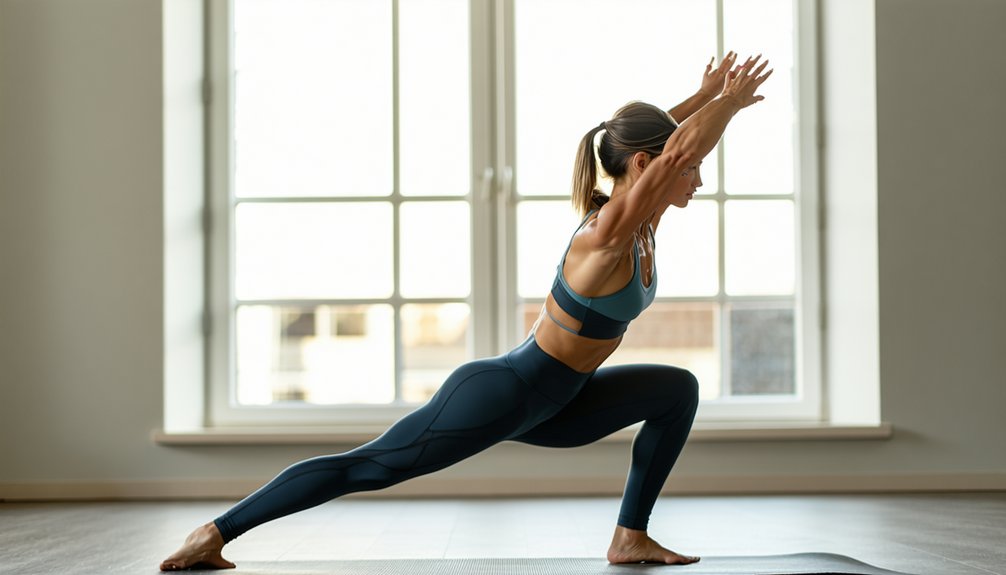
At its core, low-impact cardio keeps one or both feet on the ground—or relies on machines like bikes and rowers that eliminate ground contact altogether. You won’t find jumps, airborne phases, or hard landings here—those are the moments that spike ground-reaction force and hammer your joints. By impact measurement metrics, this style dramatically lowers the force and speed hitting your ankles, knees, hips, and spine.
You’re free to move through fluid, controlled patterns without agitating your connective tissue. These joint friendly techniques let you push your heart rate up and burn calories without gambling on injury. Whether you’re cycling, rowing, or walking briskly, you’re getting real cardiovascular work minus the punishment. That’s the freedom low-impact training gives you: intensity without the trade-off. Despite the absence of hard landings, this style of training can still be highly intense, since intensity is really driven by effort, duration, and muscular demand rather than impact alone. This approach is also considered especially appropriate for beginners in sports practice, since it builds cardiovascular capacity while minimizing early injury risk. Because at least one foot stays grounded throughout, this training style is also well suited to older adults looking for safer ways to stay active.
How Do You Know Your Heart Rate Is Up?
Feel your chest tighten slightly and your breath quicken, and you’ve got a decent clue your heart rate’s climbing—but guessing isn’t the same as knowing. You don’t need a lab to confirm it—your body and a few simple tools tell you everything.
Start with pulse checks. Press two fingers to your radial artery (inner wrist, below the thumb) or your carotid artery (side of the neck, light pressure). Count for 15 seconds, multiply by four—done. That’s your beats per minute, no guesswork required. A heart rate monitor can make this even easier if you’d rather skip the manual math, though keep in mind that certain medications can alter your heart rate response. If the numbers still feel abstract, remember that even browsing something as simple as an online marketplace like Alibaba can raise your heart rate slightly if you’re stressed about a purchase, showing how everyday moments quietly nudge your pulse.
Pair that with exertion cues: can you talk but not sing? That’s moderate intensity. Gasping after a few words? You’re in vigorous territory. Watch for faster breathing and sweating, too—your body’s honest signals that the work’s actually working. If you want a numeric target instead of relying on feel alone, your maximum heart rate can be estimated as 208 minus 0.7 times your age.
Try These Standing Moves: Curtsy Lunges and Squat Punches
Sink into a curtsy lunge and you’ll feel your glutes and quads light up without a single jump involved. Step one foot back and diagonally across your body, stopping when your front thigh hits parallel. Push through your heel to stand tall, keeping your chest proud and shoulders square—posture cues that protect your form and challenge your balance training with every rep. Aim for 3 sets of 10-12, or 20 alternating reps for a cardio burst. This move also fires up your gluteus medius, a stabilizing muscle often underactive from daily sitting.
Squat punches keep the intensity high. Drop into a squat with knees tracking over toes, then stand and throw a cross-body punch with each arm. Move fast, stay controlled, and add light weights as you progress. Monitoring your effort with the talk test can help you confirm you’re working hard enough without overexerting yourself. If you’re unsure how to structure this into a full plan, a certified personal trainer can help tailor the intensity to your fitness level. Both moves build endurance while keeping impact low and results high.
Add a Kick: Front Kick-to-Reverse-Lunge Combos

Combine strength and cardio by pairing a reverse lunge with a front kick. Start standing, feet hip-width apart, toes forward.
Step one foot back into a reverse lunge, lowering until both knees hit 90 degrees. Keep your torso upright and your core braced. Drive through your front heel, rise, and launch a front kick with your rear leg—fast and explosive.
This combo hits your glutes and hamstrings harder than forward lunges, easing stress on your knees while still torching calories. Don’t reset your feet between reps; keep the flow going for 12-15 reps per leg. Can’t kick high? A low kick still delivers results. This is largely because your front knee stays behind or directly over your toes, unlike in forward lunges, which places less pressure on the knee joint.
Warm up first with mobility flows, then challenge your stability with balance drills as you alternate legs, fists up, glutes squeezed at the top.
A 15-Minute Low-Impact Circuit You Can Do Anywhere
No equipment, no floor space requirements, no excuses—this circuit fits into a hotel room, office break, or living room between meetings.
Start with a compact warmup: marching with high knee lifts and upward arm swings, then step jacks to get your blood moving.
Move into work intervals—30 seconds on, 10 seconds off.
Hit standing elbow-to-knee crunches, traveling knee lifts (four forward, four back), and skater’s lunges to travel laterally without impact.
Pair curtsy lunges with lateral lunges as a superset, resting 10 seconds between.
Finish with wide step backs and three power punches to spike intensity before cooling down. Aim to include this style of circuit 1–2 times per week as part of your overall routine.
This circuit doubles as mobility breaks throughout your day—no gym membership required, no schedule disruption, just movement you control, anywhere you land.
Walk Your Way to a Stronger Heart
Walking rarely gets credit as “real” exercise, but your heart doesn’t care about perception—it cares about consistency.
You don’t need a gym membership or fancy gear—just steps. Aim for 8,000 to 10,000 daily, and you’ll lower your risk of early death while enhancing mental clarity. Walking spares your ankles, knees, hips, and spine, making it a sustainable entry point whether you’re starting fresh or rebuilding after injury. This is because walking is considered low-impact—one foot always stays on the ground, unlike running where both feet leave the ground, classifying it as high-impact.
Push the intensity through terrain variation—hills, inclines, uneven ground—to force your cardiovascular system to adapt without adding joint strain. You can also boost intensity by picking up your pace or increasing treadmill incline rather than relying on distance alone.
Pay attention to your breath cadence: if you can still talk but feel challenged, you’re in the sweet spot for brisk walking. This mirrors the moderate intensity range on the Borg scale used by cardiac rehab professionals, where you’re warmer and slightly breathless but still able to hold a conversation. That’s your body building real strength, one step at a time, on your own terms.
Turn Up the Incline for a Tougher Low-Impact Walk
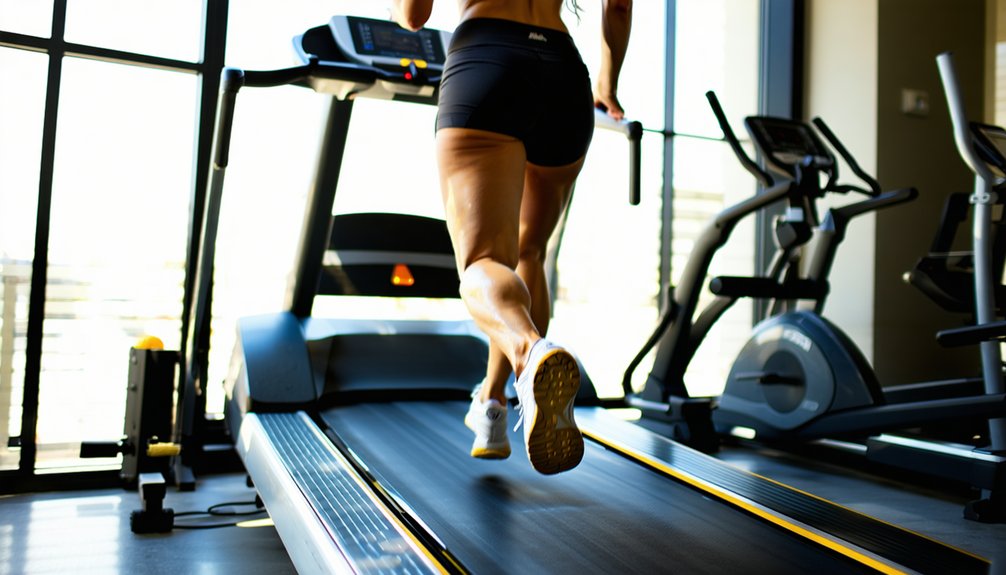
Cranking up the incline converts an ordinary walk into a legitimate cardio and strength session without adding impact on your joints.
A 1% gradient at 3 mph for 3 minutes is your starting point—bump intensity 0.5-1% every 3 minutes to keep your heart working.
Staying in the 1-3% range supports general health, while 5-10% delivers real cardiovascular challenge and greater muscle engagement. Research shows that walking at a 10% grade increases metabolic cost by 22.9% compared to flat ground.
Advanced walkers can push into 12-15% territory at slower speeds for serious intensity.
Incline intervals give you control: alternate higher gradients with recovery periods to build endurance without pounding pavement.
Smart gradient pacing means adjusting speed as incline climbs, so you’re not sacrificing form.
Track your numbers—incline, speed, duration—so every walk builds on the last one, moving you toward stronger, freer movement.
Try Backward Walking and Hamstring Curls for Variety
Regarding shaking up your routine, backward walking delivers surprising results: it raises your heart rate and oxygen consumption higher than forward walking at the same pace, even at slower speeds. You’re burning more calories without adding a single minute to your workout.
Your quads, hamstrings, and glutes work harder while your knees experience less stress—a win for anyone protecting their joints. Backward walking also strengthens the muscles stabilizing your spine and enhances hamstring flexibility.
Want to double down? Add hamstring curls to your routine. They target the same muscle group backward walking activates, building strength and balance from multiple angles.
Start with one- to two-minute intervals in a flat, obstacle-free space, then mix in curls for a well-rounded, joint-friendly session that keeps your body guessing.
Low-Impact Cardio in the Pool and on Machines
If backward walking and hamstring curls have you craving more variety, water’s the next logical move. Water delivers 12 to 15 times more resistance than air, so every push and kick works harder without punishing your joints. Buoyancy cuts impact by up to 90%, freeing your knees and hips to move fast and full-range. Try water jogging with high knees, flutter kicks, or scissor kicks against the pool edge. Grab resistance paddles or dumbbells for bicep curls, tricep extensions, and chest presses—chest-deep water amplifies the burn. Mix in aqua dance for rhythm-driven cardio that doesn’t feel like work.
Prefer dry land? Ellipticals, recumbent bikes, rowing machines, and climbers deliver zero-impact intensity, keeping your heart rate up while protecting your joints.
Build a Low-Impact Circuit With Bodyweight and Equipment
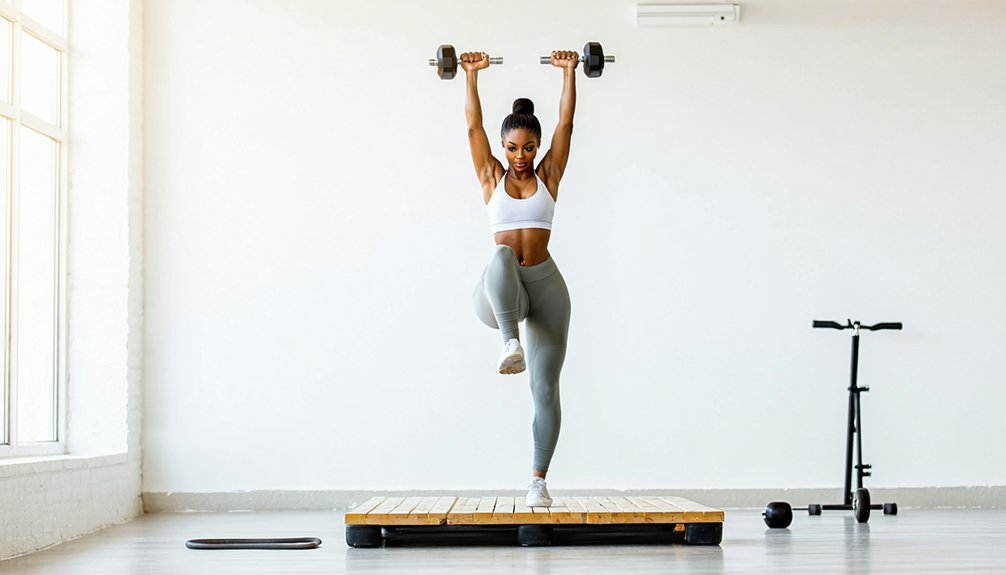
Grab a mat, a set of dumbbells, or a resistance band, and you’ve got everything you need to build a low-impact circuit that spikes your heart rate without pounding your joints.
Start with 5 minutes on a recumbent bike, then loosen up with bodyweight squats and mat mobility work like cat cows and threading the needle.
For the main circuit, pair banded rows with dumbbell thrusters, Russian twists, and bicep curls.
Work 45 seconds on, rest 15 seconds, and push through 2-3 rounds with a 1-minute break between them.
This keeps your heart rate in that 50-85% zone while your joints stay protected.
Cool down for 2-10 minutes with wall squats or exercise ball rollouts.
Hit this circuit 2-3 times weekly, and you’ll build strength that feels freeing, not punishing.
Sneak in Strength and Flexibility With Low-Impact Pilates
Rolling out your mat opens the door to a workout that builds strength and flexibility while quietly training your heart. Pilates isn’t just stretching—it’s breath centered toning that engages your cardiovascular system while sculpting muscle. Leg circles, plank variations, and push-ups increase your heart rate without stressing your joints. The side kick series activates large muscle groups, enhancing circulation and endurance. You’ll build core controlled mobility through pelvic tilts and leg slides, safe moves that strengthen your center without strain.
Breath drives every rep: rapid breathing in “The Hundred” fuels oxygen intake, while controlled inhales and exhales stimulate circulation throughout your practice. Research backs it up—Pilates raises VO2 max, improves cardiac output, and strengthens left ventricular function. You’re not just moving; you’re rewiring your heart’s efficiency, one deliberate breath at a time.
How to Progress Your Low-Impact Routine Over Time
Building endurance takes patience, not guesswork. Start with 10–20 minute sessions, three days a week, then add a fourth day after 2–3 weeks. Every two weeks, extend your sessions by 5 minutes—this is progressive overload in action, building capacity without stressing your joints.
Tempo control gives you another lever to pull. Slow your movements down to intensify muscle engagement, or use 45-second work intervals with 15-second rest periods to challenge your cardiovascular system safely. Rapid-tempo glute bridges or controlled high knees raise your heart rate without impact.
Track more than weight—watch your heart rate and recovery time. If your heart rate drops quickly post-exercise, you’re ready to progress. Consider a DEXA scan to establish your baseline and measure real change.
Frequently Asked Questions
Can Low-Impact Cardio Help With Weight Loss as Effectively as High-Impact Workouts?
Yes, you’ll get comparable results! Low-impact cardio triggers similar metabolic adaptation as high-impact training while enhancing exercise adherence. You’re free to skip joint-pounding workouts—consistency, not intensity, drives your fat-loss freedom and long-term success.
How Many Days per Week Should I Do Low-Impact Cardio for Best Results?
You’ll want to hit 3-5 days weekly, following frequency guidelines that fit your life. Start at 3 if you’re new, build up gradually. Don’t skip recovery days—they’re where your freedom to keep moving comes from!
Is Low-Impact Cardio Suitable for People With Arthritis or Joint Pain?
Yes, you’ll find it ideal. Joint friendly modifications like walking or cycling ease stress on painful areas, while aquatic options use water’s buoyancy to protect joints. You’ll strengthen muscles, ease stiffness, and reclaim movement freedom safely.
Can I Combine Low-Impact Cardio With Strength Training on the Same Day?
Yes, you can! Just prioritize schedule sequencing—separate sessions by 3-6 hours when possible. Pair low-impact cardio with lifting days freely, and use smart recovery strategies like proper fueling and rest. You’re free to build your own rules.
What Should I Eat Before and After a Low-Impact Cardio Workout?
Eat a banana or protein shake as pre workout snacks 30-60 minutes before you start. After finishing, prioritize recovery nutrition—pair carbs with protein, like chocolate milk or fruit—within 45 minutes to refuel and rebuild freely.
Conclusion
You don’t need to jump or pound pavement to get your heart pumping. You’ve got curtsy lunges, kick combos, pool intervals, and Pilates flows—all proven to challenge your cardiovascular system without stressing your joints. Start with the 15-minute circuit, track your heart rate, and progress by adding reps, resistance, or tempo. Consistency beats intensity every time, so pick a move you’ll actually stick with and build from there.
References
- https://www.healthline.com/health/fitness-exercise/low-impact-cardio
- https://sweat.com/blogs/fitness/low-impact-cardio
- https://www.bhf.org.uk/informationsupport/heart-matters-magazine/activity/aerobic-exercises
- https://www.silversneakers.com/blog/the-best-low-impact-cardio-exercises/
- https://www.youtube.com/watch?v=kRk3w1uZY0E
- https://www.eosfitness.com/blog/low-impact-cardio-exercises
- https://www.prevention.com/fitness/workouts/a60597573/low-impact-cardio/
- https://enfaf.com/ejercicios-bajo-impacto/
- https://beone.es/entrenamiento-de-cardio-de-bajo-impacto
- https://vasafitness.com/es/blog/what-is-low-impact-cardio/

