
Social connection belongs in your wellness routine because it directly shapes your physical and mental health. Strong relationships can elevate your survival odds by 50%, while loneliness raises your risk of heart disease, dementia, and early death. Connection also calms your nervous system, strengthens immunity, and cuts depression risk by 47%. It’s not just emotional support—it’s biology. Here’s what’s really happening beneath the surface, and how to utilize it.
TLDR Key Takeaways
- Loneliness raises heart disease risk by 29%, dementia by 40%, and premature death by 26%.
- Strong relationships boost survival odds by 50%, with socially integrated women living 10% longer.
- Social support cuts depression odds by 47% and reduces suicide risk by 74% with close connections.
- Weekly social engagement slows memory decline and builds cognitive reserve against age-related changes.
- Oxytocin released during bonding lowers blood pressure, reduces pain, and calms the nervous system.
What Does Social Connection Really Mean?
What Does Social Connection Really Mean?
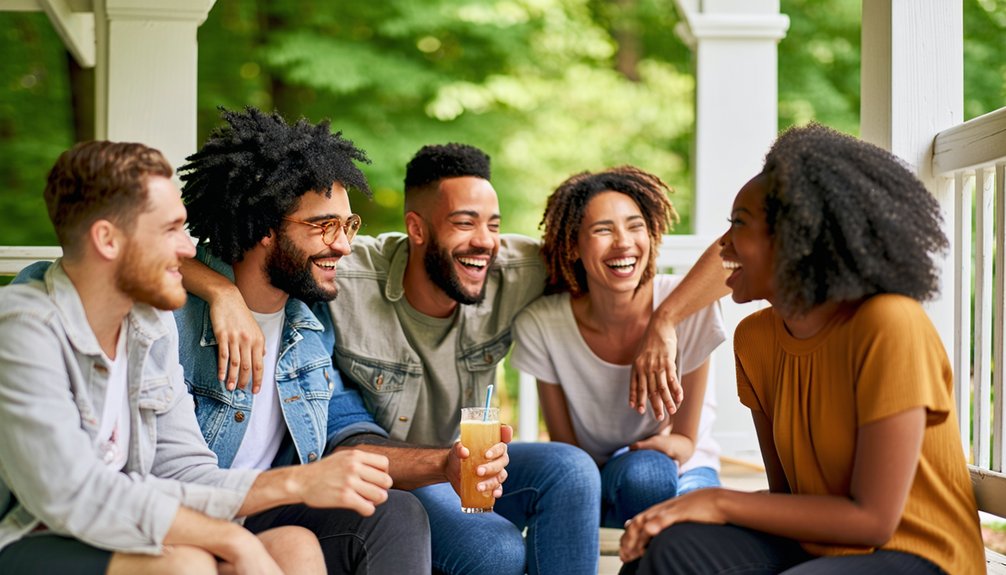
When you hear “social connection,” you might envision a quick chat with a coworker or a weekend call with family. But it’s bigger than that. It’s feeling seen, heard, and valued—the emotional attunement that makes you feel truly known.
It’s also structural: the size and diversity of your network, spanning family, friends, and acquaintances. Then there’s function—the support you give and receive, whether emotional, financial, or informational.
Quality matters too: shared rituals and positive interactions build connection, while conflict erodes it. The Surgeon General ranks this need alongside food, water, and shelter. Brené Brown describes this energy as what happens between people when they feel seen, heard, and valued. Understanding these dimensions frees you to stop settling for surface-level contact and start building relationships that actually sustain you. This matters because social connectedness reflects the continuum of meeting social connection needs. In fact, roughly one in six people worldwide report experiencing loneliness.
How Does Loneliness Silently Damage Your Health?
Once you understand what genuine connection looks like, the cost of its absence becomes impossible to ignore.
Loneliness doesn’t just make you feel bad—it rewires your biology. Your body reads isolation as a threat, flooding your system with cortisol and triggering chronic inflammation that damages your heart, weakens your immunity, and accelerates brain aging. This isn’t abstract: loneliness raises your risk of heart disease by 29%, dementia by 40%, and premature death by 26%.
It fuels sleep disruption, keeping you locked in fight-or-flight mode long after any real danger has passed. Researchers now rank its health impact alongside smoking 15 cigarettes a day. More than half of Americans report feeling lonely on a daily basis, showing just how widespread this hidden threat has become. Chronic loneliness has even been linked to reduced grey matter volume in brain regions responsible for memory and learning. Your isolation isn’t just emotional pain—it’s a measurable, physical threat demanding your attention. Even without feeling lonely, social isolation alone can pose a serious risk to your health.
Why Are Connected People More Likely to Live Longer?
Longevity isn’t luck—it’s biology responding to connection. When you build strong social bonds, you literally rewire your survival odds. Research spanning 148 studies shows people with solid relationships have a 50% greater chance of survival than those without. Socially integrated women live 10% longer and have 41% higher odds of reaching 85.
Your daily social rhythms matter more than occasional check-ins—consistent interaction, not sporadic contact, drives these results. Community rituals like shared meals, volunteering, or regular gatherings lower cortisol, reduce inflammation, and protect your heart and brain simultaneously. In fact, loneliness alone increases the risk of premature death by 26%.
This isn’t about willpower—it’s about wiring your life for biological support. Every connection you nurture is a vote for more years, lived freely and fully. Beyond survival odds, deep support networks are linked to slower biological aging at the cellular level, meaning connection can literally slow down how your body ages. A large study of older adults found that survival benefits increased incrementally with socializing frequency, with daily socializing showing the clearest advantage over time.
How Does Social Connection Strengthen Your Immune System?
Beyond adding years to your life, connection changes what’s happening inside your cells right now. Your body reads social contact as a safety signal, activating vagus mediated immunity that calms your nervous system while sharpening immune cell responses. This isn’t abstract—dopamine activation in your brain’s reward centers directly enhances peripheral immunity, helping cells fight tumors and infections more effectively.
Meanwhile, oxytocin mediated resilience lowers blood pressure, reduces pain, and buffers stress’s damaging effects on your body. Where loneliness increases inflammation and suppresses antiviral defenses, connection does the opposite: it dials down inflammatory gene expression while strengthening your antiviral response. Chronic loneliness has also been linked to elevated pro-inflammatory cytokines and lasting inflammation throughout the body. Steve Cole’s research confirms this isn’t coincidence—social bonds directly influence gene expression governing immune function. In fact, social disconnection has been shown to predict vulnerability to disease and death beyond traditional risk factors like smoking or obesity. Your relationships are literally rewriting your biology. Researchers have even identified specific proteins, such as ADM, that rise with loneliness and are tied to stress hormone regulation and increased risk of early death.
How Does Connection Affect Your Mental Health?
Resilience isn’t something you build alone—it’s something connection builds in you. Your mind and body are wired for it. Social support, whether received or perceived, cuts depression odds by 47% across your lifespan. Frequent connection stands as the single strongest protective factor against depression among over 100 studied variables.
Isolation fuels anxiety and can spiral into thoughts of self-harm—but even 3 to 4 close connections slash suicide risk by 74%. Your attachment styles shape how you seek and receive this protection, while oxytocin release during bonding moments calms your nervous system and steadies your mood. In fact, lonely people face twice the likelihood of experiencing depression.
Connection doesn’t just prevent suffering—it builds self-esteem, empathy, and trust, freeing you to show up as your fullest self. Beyond mental health, strong social ties can even boost longevity by 50%.
Can Strong Social Bonds Sharpen Your Cognitive Function?
Your brain benefits from connection just as much as your mood does. Strong social bonds build cognitive reserve, giving your mind more capacity to withstand age-related changes. Weekly engagement with friends, family, or community groups slows memory decline and protects language and global cognition.
Loneliness works against you—it raises dementia risk by 42%, while chronic isolation pushes that risk up to 50%. Strong social engagement, on the other hand, cuts dementia risk by roughly 19%.
Your network matters too. Larger circles, especially ones with non-kin ties, sharpen cognition more than tight, dense groups. Even brief daily interactions can boost cognitive performance, with pleasant social exchanges linked to sharper thinking that day and over the following two days. Every meaningful interaction strengthens your social reserve, activates neural circuits, and builds brain resilience against stress and neuropathology. Stay connected—your mind depends on it.
Why Is Isolation Riskier Than Smoking or Obesity?
When you feel chronically lonely, you’re doing more damage than a pack of cigarettes a day—at least according to the U.S. Surgeon General.
The Million Women Study found a 30% excess mortality risk tied to isolation, while the UK Biobank showed the most isolated face a 40% higher death risk than the least.
You’re looking at hazards that outpace obesity, inactivity, and even excessive drinking.
This isn’t just personal health—it’s health economics on a massive scale, straining systems that weren’t built to treat disconnection as a disease.
The policy implications are staggering: if isolation rivals smoking as a killer, it deserves the same public health urgency.
Your relationships aren’t optional extras—they’re frontline medicine you can’t afford to skip.
Which Community Groups Build Real Social Connection?
Not all groups deliver the same connection payoff, so choosing wisely matters. Identity-based communities, like ethnic organizations or grief support groups, give you deep trust and emotional safety, but they demand real engagement, not passive membership. Activity-based groups, including community gardening, bond you with others through shared work and purpose rather than shared identity. Third-place environments, cafés, gyms, dog walking groups, create low-pressure spaces where organic connection happens without effort. Digital platforms like Meetup or Discord help you find niche groups before meeting in person. Civic and volunteering communities align you with people who share your values, strengthening both you and your neighborhood. Pick the structure that matches what you actually need, then show up consistently.
How Does Volunteering Boost Your Own Well-Being?
Giving your time to others pays you back in measurable ways. When you volunteer, you counteract stress, anxiety, and depression through genuine social contact. Studies confirm volunteers report better mental health, higher life satisfaction, and stronger self-esteem than non-volunteers. Your body benefits too: regular service lowers blood pressure, reduces inflammation, and even cuts mortality risk when you hit 100+ hours a year.
You don’t need a massive commitment to start. Micro volunteering—small, flexible tasks you complete in minutes—delivers real impact without draining your schedule. Try skill exchange programs, where you trade your know-how for someone else’s, building community while sharpening your abilities. Two hours a week is your baseline; beyond that, purpose and connection compound, freeing you from isolation and reinforcing resilience.
How Often Should You Check In With Friends?

Volunteering builds connection with strangers, but your existing friendships need their own maintenance schedule.
Your check in cadence should match the tier of the friendship, not guilt or habit. Close friends need contact every 1-2 weeks; good friends every 2-4 weeks; acquaintances every 1-3 months.
Crisis moments override the default: shift to weekly or even daily contact when someone’s grieving, sick, or coping with a breakup, and don’t retreat once the acute phase passes.
Make it count. Ask open-ended questions instead of “are you ok?”
Keep interactions bidirectional and respect privacy boundaries—no distractions, no leaks, just presence.
You don’t need a reason to reach out. Anchor check-ins to existing routines, rotate through your list weekly, and let consistency—not perfection—define the friendship.
Is Social Media Helping or Hurting Your Connections?
Because social media’s effects on your relationships depend entirely on how you use it, the same platform can strengthen one friendship while quietly eroding another. Active engagement—commenting, sharing, checking in—expands your network; frequent users report 27.3% larger communication circles than non-users.
But passive scrolling breeds isolation. Adolescents logging heavy screen time while skipping face-to-face contact report the highest loneliness levels, and problematic use correlates with anxiety, depression, and low self-esteem.
You’re also vulnerable to parasocial ties: one-sided digital connections that feel meaningful but leave you emotionally unfed. Reconnecting with exes or comparing your relationship to curated highlight reels breeds jealousy and mistrust.
The fix isn’t quitting—it’s intention. Use social media to deepen real bonds, not replace them. Choose active participation over passive consumption, and protect your in-person time fiercely.
Can Friendships With Different People Enrich Your Life?
Screens aren’t the only place your social circle needs attention—who’s actually in that circle matters just as much. Friendships that cross cultural, racial, age, and gender lines don’t just diversify your social feed—they rewire how you perceive the world.
A meta-analysis of 135 studies confirms that cross-group friendships build more positive intergroup attitudes through intercultural empathy and immersion exchange. These bonds also protect you physically: people with diverse friendships show lower stress reactivity in unfamiliar intergroup settings and feel buffered against the anxiety of expected rejection.
You’re not just collecting acquaintances—you’re expanding your capacity for understanding while your nervous system relaxes into unfamiliar spaces. That’s liberation in action: fewer walls, less fear, more room to grow beyond the boundaries you didn’t choose.
Frequently Asked Questions
Can You Improve Social Connection if You’re Naturally Introverted?
Yes, you can. You don’t need to become an extrovert—you just build intentional rituals, like standing coffee dates, and join groups around shared interests. Small, structured steps free you from pressure while genuinely expanding your connections.
How Long Does It Take to Feel the Health Benefits of Connection?
You’ll feel benefits fast: a hug shifts your immediate mood within minutes through dopamine release. Weeks of consistent contact strengthen your immune response and lower inflammation. Years of connection extend your lifespan—benefits compound the more you engage.
What if I Live Far From Family and Close Friends?
You don’t need proximity to build connection. Join local groups—hiking, art, volunteering—to meet people nearby. Schedule virtual meetups or weekly calls with distant loved ones. You’re free to build support wherever you are.
Can Online-Only Relationships Ever Replace In-Person Connection?
Not fully. Virtual intimacy and digital empathy genuinely nourish you, easing isolation and building real closeness. But you’re wired for physical presence—so let online bonds free you, while still pursuing face-to-face moments when possible.
How Do I Rebuild Connections After Years of Isolation?
You rebuild through gradual exposure—start small, low-pressure contact, then commit to shared activities like a class or club. Show up consistently, practice self-compassion, and let genuine bonds form naturally over time.
Conclusion
Your health depends on more than diet and exercise—it depends on the people around you. When you nurture real connections, you lower stress, enhance immunity, and add years to your life. Don’t treat social wellness as optional. Call a friend, join a group, volunteer, or simply check in more often. Small, consistent efforts compound over time. Make connection a daily habit, not an afterthought, and you’ll strengthen both your mind and body.
References
- https://www.cdc.gov/social-connectedness/about/index.html
- https://pmc.ncbi.nlm.nih.gov/articles/PMC11403199/
- https://hsph.harvard.edu/news/the-importance-of-connections-ways-to-live-a-longer-healthier-life/
- https://ccare.stanford.edu/uncategorized/connectedness-health-the-science-of-social-connection-infographic/
- https://mhanational.org/resources/connect-with-others/
- https://pmc.ncbi.nlm.nih.gov/articles/PMC6125010/
- https://www.hhs.gov/sites/default/files/sg-social-connection-individuals.pdf
- https://www.who.int/news/item/30-06-2025-social-connection-linked-to-improved-heath-and-reduced-risk-of-early-death
- https://www.healthline.com/health/stress/social-wellness
- https://en.wikipedia.org/wiki/Social_connection

