
You should start colorectal cancer screening at 45 if you’re average-risk, since rising rates in younger adults prompted USPSTF and ACS guidance changes. Options include colonoscopy every 10 years, annual FIT, or stool DNA every 3 years. If you have IBD, Lynch syndrome, or a first-degree relative diagnosed young, you’ll need to start earlier. Each test differs in accuracy, prep, and follow-up requirements—details worth knowing before you choose.
TLDR Key Takeaways
- Average-risk adults should start colorectal cancer screening at age 45, per USPSTF and ACS guidelines.
- Family history or genetic conditions like Lynch syndrome can require screening as early as age 20–40.
- Colonoscopy is the gold standard, detecting over 98.5% of advanced adenomas every 10 years.
- FIT and stool DNA tests offer non-invasive alternatives, done annually or every 3 years respectively.
- Screening should continue through age 75, with individualized decisions for ages 76–85.
Why Colorectal Cancer Screening Starts at Age 45

Because colorectal cancer rates in adults under 50 have climbed sharply, screening guidelines no longer start at age 50. You’re facing a different risk environment than previous generations, and the data demands action, not delay.
Four independent models, including CISNET-CRC and Stanford’s Laudabaum model, confirm age 45 as the most efficient starting point. Men gain maximal benefit at 45; women at 47, though 45 remains standard for you if you’re average-risk.
The USPSTF backs this with moderate-certainty evidence: screening from 45-49 delivers real net benefit. The ACS made this call first in 2018, and USPSTF followed in 2021. This recommendation for adults 45-49 carries a grade of B. Screening works because it can catch and remove precancerous polyps before they ever turn into cancer.
Earlier detection saves your life. Don’t let screening disparities keep you from claiming that advantage—demand access, know your options, and start now. If you’re in good health with a life expectancy over 10 years, guidelines support continuing screening through age 75.
Do You Have Risk Factors That Change Your Screening Start Age?
If your medical history includes radiation, IBD, or prior polyps, age 45 doesn’t apply to you—your clock starts much earlier. Prior abdominal or pelvic radiation triggers screening 10 years post-treatment or at 35, whichever comes later. IBD demands colonoscopy 8 years after diagnosis, with follow-ups every 1-3 years. Personal history of adenomatous polyps or CRC overrides average-risk timelines entirely, defaulting you to colonoscopy surveillance.
Beyond these clear triggers, consider your fuller risk profile: obesity, smoking, diabetes, and Ashkenazi Jewish ancestry compound your baseline risk. Lynch syndrome, caused by inherited defects in genes like MLH1 or MSH2, can raise lifetime colorectal cancer risk as high as 50% and warrants much earlier surveillance. Family history of colorectal cancer or polyps in a first-degree relative is itself a well-established risk factor that can shift your recommended starting age, and having a first-degree relative diagnosed with CRC alone raises an individual’s risk two- to threefold. While occupational exposures and lifestyle factors don’t officially shift start age per guidelines, they inform urgency conversations with your provider. Discuss medication interactions and family history openly—your screening plan should reflect your actual risk, not a generic timeline. Own your data.
Family History and Genetic Risk: When to Screen Earlier
When one first-degree relative develops CRC, your risk doubles—and your start age depends entirely on when they got diagnosed.
If they were 60 or older, you follow average-risk guidelines and start at 45. If they were under 60, you start at 40. Two or more first-degree relatives, diagnosed at any age? Start at 40, no exceptions.
Colonoscopy is your preferred test here, repeated every 5 years if results come back clean. Can’t get one done? FIT testing every 1-2 years works as a backup. Beyond blood tests, pre-cancerous polyps can be removed during the procedure itself, stopping cancer before it starts.
Suspect Lynch syndrome or FAP in your family? Genetic counseling determines whether you need pediatric screening—sometimes starting in your teens, with annual colonoscopies once confirmed. Don’t wait for symptoms to claim this knowledge.
IBD and Radiation Exposure: When Should You Start Screening Earlier?

Living with inflammatory bowel disease changes your CRC screening timeline entirely, since chronic inflammation—not age or family history—drives your risk. If you have pancolitis, screening starts at 8 years; left-sided colitis pushes that to 10 years. PSC diagnosis erases the waiting period—you need a colonoscopy immediately, then annually for life. Personal dysplasia history or a first-degree relative diagnosed young triggers similar timing adjustments to your screening thresholds. Studies show CRC risk in IBD patients is estimated at 2 to 5 times higher than in the age-matched general population.
Radiation exposure matters too. If you’ve had pelvic radiation or significant occupational exposure to ionizing radiation, don’t wait for standard guidelines—talk to your doctor about earlier screening. Your cumulative inflammatory burden and exposure history—not a calendar age—determine when you start. Own your risk factors, demand appropriate timing, and take control of your surveillance plan.
Stool-Based Screening Tests: FIT, gFOBT, and Stool DNA Explained
Not every screening test works the same way, and knowing the differences helps you choose wisely.
FIT detects hidden blood from your lower intestines with strong sensitivity and fewer false-positives than other options. It’s recommended annually starting at age 45, with no dietary restrictions—true at-home collection freedom.
High-sensitivity gFOBT also works annually but requires you to avoid certain foods and medications beforehand, unlike FIT.
Stool DNA testing represents real biomarker advances: it checks for blood plus shed DNA from polyps and cancer, catching more advanced lesions than FIT or gFOBT. You’ll repeat it every 3 years starting at 45. Kits like Cologuard include a preservative along with the FIT component to keep the sample stable during shipping. This test is prescription-only, so you’ll need to arrange it through a healthcare provider before it can be mailed or dispensed.
Any positive result demands a follow-up colonoscopy—no exceptions.
Colonoscopy: What Actually Happens During the Procedure
Colonoscopy prep typically starts several days before your actual procedure. You’ll cut back on high-fiber foods, then switch to clear liquids the day before. Laxatives clean out your colon completely—this part isn’t glamorous, but it’s essential.
On procedure day, you’ll lie on your left side while sedation options take effect, keeping you relaxed and pain-free. The doctor guides a thin, flexible scope through your entire colon, using air and water for clear visibility. Expect 30-60 minutes total. This procedure is performed by a gastroenterologist or surgeon with specialized endoscopy training.
If polyps appear, they’re removed immediately—no extra wait, no separate surgery. You might feel bloating or cramping during air infusion, but sedation blocks real pain. You may also notice mild bleeding or blood in your stool for a couple of days afterward, which is common.
Recovery expectations: about 30 minutes of observation, then you’re free to go home with someone driving you, since full clearance of anesthesia takes about 24 hours.
Lower-Prep Alternatives: CT Colonography and Flexible Sigmoidoscopy
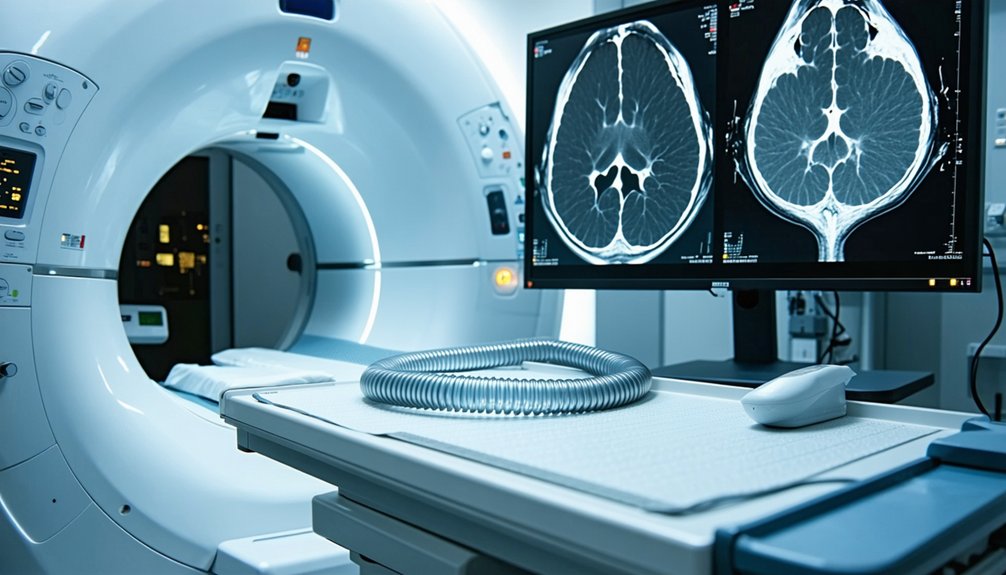
Balancing prep burden against diagnostic accuracy, CT colonography (CTC) offers a real trade-off worth understanding. Full laxative prep detects 97% of polyps ≥6mm with 92% specificity, versus 88% sensitivity and 68% specificity with minimal prep. That drop matters—you shouldn’t assume lighter prep means equal protection.
Good news: newer regimens improve patient tolerability without sacrificing image quality. One-day meglumine-ioxithalamate schemes rate better than 2-day versions, and low-dose PEG-bisacodyl protocols achieve diagnostic-quality results in 97.4% of segments. A same-day 1-L PEG plus bisacodyl regimen with iodine tagging has shown comparable bowel cleansing to standard day-before iodine-only preparation. For frail elderly patients, limited-prep CTC delivers 100% sensitivity and zero false-negatives—real flexibility when full prep isn’t feasible.
You’re not stuck with one-size-fits-all. 80% of patients actually prefer CTC over colonoscopy, giving you a lower-burden path that still catches what matters. Flexible sigmoidoscopy data remains limited in current sources.
How Often Should You Get Screened for Colorectal Cancer?
Frequently, the right screening interval depends entirely on which test you choose and where you fall on the risk range. If you’re average-risk, colonoscopy every 10 years gives you the longest gap between visits—ideal if lifestyle impact matters to you.
Prefer less invasive options? FIT works annually, mt-sDNA (Cologuard) every 3 years, and flexible sigmoidoscopy or CT colonography every 5 years. Notably, guidelines now recommend screening begin at ages 45–49 for average-risk adults, reflecting evidence of meaningful benefit in this age group.
High-risk individuals—especially those with a first-degree relative history or Lynch syndrome—need tighter intervals: colonoscopy every 5-10 years, or even 1-2 years for HNPCC patients starting at 20-25.
Before choosing, check your insurance coverage—many plans fully cover screening within recommended windows, freeing you from unnecessary out-of-pocket costs.
What Happens After an Abnormal Screening Result?
Once you’ve settled on a screening schedule, the next question is what happens if your results come back abnormal. You don’t repeat the stool test—you move straight to colonoscopy, ideally within 60 days. Delays let pre-cancerous polyps progress, so don’t wait.
Here’s liberating perspective: 10–15% of FIT tests come back abnormal, yet over 96% of those people don’t have cancer. An abnormal result means “investigate further,” not “you have cancer.”
During the colonoscopy, providers remove and biopsy any suspicious tissue, with results typically ready within a week. Know your insurance implications beforehand—diagnostic follow-ups may be billed differently than routine screening. Lean on emotional support from providers or loved ones while you wait; anxiety is valid, but statistics are on your side.
How Accurate Are Colorectal Cancer Screening Tests?
How Accurate Are Colorectal Cancer Screening Tests?
Because every screening test trades off sensitivity for convenience, accuracy varies widely depending on which one you choose. Colonoscopy remains the gold standard: over 99% accurate, with 98.5% sensitivity for advanced adenomas.
Stool DNA tests like Cologuard Plus catch 95% of cancers but only 40% of precancerous polyps—know your test limitations before you decide.
FIT tests detect 80% of cancers but just 28-42% of advanced adenomas, requiring annual repetition.
Blood tests represent emerging biomarkers in this space: Shield catches 83% of cancers overall, though only 65% of Stage I cases.
Every positive result—stool or blood—demands colonoscopy confirmation. You deserve informed choice: understand what each test actually detects before trusting it with your health.
When Should You Stop Colorectal Cancer Screening?
Knowing which test to choose only solves half the equation—you also need to know when to stop. The USPSTF backs screening through age 75 for average-risk adults. Past that, screening cessation depends on your health, not just your birthday. Life expectancy under 10 years means screening offers no benefit—stop regardless of age. Prior colonoscopy history matters too: a clean test 10+ years back lets you consider stopping at 74 or 75. Severe comorbidities push that number down to 66; excellent health with no prior screening can push it to 90.
Ages 76-85 require individualized care through shared decision making—weighing your history, health, and preferences with your provider. After 85, evidence runs out: screening isn’t recommended for anyone in that group.
Why Sticking to Your Screening Schedule Actually Saves Lives
Sticking to your screening schedule isn’t just a box to check—it’s what actually drives down your risk of dying from colorectal cancer. Consistency matters: biennial FIT cuts mortality by 36% to 72%, while gFOBT lowers CRC-specific death risk with a relative risk of 0.78 over 30 years. Skip a screening, and you widen the window for unnoticed polyp growth. Colonoscopy every 10 years, or annual stool tests, only work if you show up on time—every time.
That’s where behavioral interventions and screening incentives come in. They’re not gimmicks; they’re tools that help you stay on track when life gets in the way. USPSTF modeling shows 100% adherence starting at 45 yields the greatest life-years gained. Your consistency is your power—use it.
Frequently Asked Questions
Does Insurance Typically Cover the Cost of Colorectal Cancer Screening Tests?
Yes—your insurance coverage typically pays fully for colorectal screening. You’ll owe zero out-of-pocket costs for tests like colonoscopies or Cologuard if you’re average-risk, ages 45+, and use in-network providers. Polyp removal may trigger coinsurance.
Can I Choose Which Screening Test Is Right for Me, or Does My Doctor Decide?
You choose together—it’s shared decision making, not doctor-dictated. Your patient preference matters: weigh accuracy, convenience, and frequency with your doctor’s guidance. You’re enabled to select the test that fits your life, risk profile, and comfort level.
What Should I Eat or Avoid Before a Colonoscopy or Other Screening Test?
You’ll follow a low-fiber diet, then switch to clear liquids day before—broth, apple juice, gelatin. Avoid red/purple colors and dyes. Skip supplements. Keep dental hygiene routines normal—brushing’s fine, just don’t swallow mouthwash!
Are There Age or Health Conditions That Make Screening Tests Riskier to Perform?
Yes—as an older patient, you face higher risks: perforation, bleeding, contrast complications. Your comorbidity management matters most; frailty and life expectancy under 5-10 years often outweigh benefits. You decide with your doctor, not by age alone.
How Do Blood-Based Tumor DNA Tests Compare to Stool-Based and Visual Screening Options?
You’ll find blood-based specificity strong (91.5%), but you’re trading away sensitivity for early lesions. Stool-based adherence often wins long-term protection—colonoscopy and stool tests catch precancers blood draws simply miss.
Conclusion
You don’t need to guess when to start—if you’re 45, it’s time to screen. You know your risk factors matter, so talk to your doctor if you’ve got a family history, IBD, or prior radiation exposure. Whether you choose a stool-based test or colonoscopy, you’re taking a step that catches problems early. Stick to your schedule, follow up on abnormal results, and you’ll cut your colorectal cancer risk substantially (USPSTF, 2021).
References
- https://www.cancer.org/cancer/types/colon-rectal-cancer/detection-diagnosis-staging/acs-recommendations.html
- https://www.uspreventiveservicestaskforce.org/uspstf/recommendation/colorectal-cancer-screening
- https://www.cdc.gov/colorectal-cancer/screening/index.html
- https://www.nccn.org/patients/guidelines/content/PDF/colorectal-screening-patient.pdf
- https://journals.lww.com/ajg/fulltext/2021/03000/acg_clinical_guidelines__colorectal_cancer.14.aspx
- https://gi.org/topics/colorectal-cancer/
- https://www.facingourrisk.org/info/risk-management-and-treatment/screening-and-risk-reduction/by-cancer-type/colorectal/screening
- https://www.aafp.org/afp/2022/0300/p327
- https://pressroom.cancer.org/colorectal-cancer-screening-guideline-update-2026
- https://www.cancer.org/health-care-professionals/american-cancer-society-prevention-early-detection-guidelines/colorectal-cancer-screening-guidelines.html

