
If you’re a Black woman with sleep apnea, you might not snore loudly—or at all. Your symptoms often look like insomnia, morning headaches, brain fog, nocturia, or mood swings instead. Up to 86% of Black women with OSA go undiagnosed because clinicians dismiss these signs as stress or hormones. Partial airway blockages, common in women, produce subtler clues than the gasping typically seen in men. Understanding what your body’s actually telling you changes everything ahead.
TLDR Key Takeaways
- Many Black women with sleep apnea snore less than men, causing partners and clinicians to miss diagnosis.
- Fatigue, insomnia, morning headaches, and brain fog often signal airway trouble even without snoring.
- Nighttime urination and nightmares are frequently overlooked as unrelated to obstructive sleep apnea.
- Mood swings and anxiety are often misattributed to hormones instead of investigated as apnea symptoms.
- Partial airway blockages, common in women, cause micro-awakenings, adrenaline surges, and racing heart at night.
Why Sleep Apnea Looks Different in Black Women
When it comes to sleep apnea, Black women don’t get the same warning signs—or the same outcomes—as everyone else. Your apnea-hypopnea index runs higher, your symptoms hit harder, and disease shows up younger than in White patients. This isn’t coincidence—it’s biology meeting systemic neglect.
Hormonal influences shape how your body responds to airway obstruction, while chronic stress from neighborhood disadvantage compounds the physical toll. You’re not imagining the fatigue, the headaches, the racing heart at 3 a.m. Black adults also tend to experience more severe obstructive sleep apnea at younger ages than their counterparts. Left untreated, this can raise the risk of serious complications, including insulin resistance and type 2 diabetes.
Healthcare access remains the breaking point: only 16.2% of Black patients with moderate-to-severe OSA ever get diagnosed, despite carrying the heaviest symptom burden. Snoring gets normalized. Warning signs get dismissed. Even the diagnostic tools themselves fall short, as pulse oximetry shows reduced accuracy in detecting oxygen desaturations in people with darker skin. Your body’s truth deserves recognition—not silence, not delay. Understanding these differences is the first step toward reclaiming your health.
The Underdiagnosis Crisis in Black Communities
Nearly 95% of African Americans with obstructive sleep apnea walk around undiagnosed and untreated—a staggering gap that exposes just how broken the detection system really is.
Only 5% of Black folks with moderate or severe OSA ever get a diagnosis. Even when your doctor refers you to a sleep clinic, only 38% of you follow through. That’s not carelessness—it’s community mistrust built from decades of medical neglect, plus insurance coordination nightmares that make specialist care feel out of reach. This data comes from the Jackson Heart Study, the largest study of cardiovascular disease in African-Americans.
Add sleep labs stuck in affluent neighborhoods, transportation barriers, and limited health education, and you’ve got a system engineered to miss you. This underdiagnosis carries serious consequences, as untreated sleep apnea is linked to higher rates of hypertension, heart disease, stroke, and diabetes. Making matters worse, common diagnostic tools like pulse oximetry show reduced sensitivity in detecting oxygen desaturations in people with darker skin, further risking missed diagnoses.
You deserve better than a healthcare structure that requires you to fight for basic diagnosis. Your sleep—and your life—depend on breaking this cycle.
Why Snoring Alone Isn’t Enough
If you’re waiting for a loud snore to confirm sleep apnea, you’re using the wrong yardstick. Your bedtime routines might mask the real signs—alcohol, sleep position, and fragmented rest all shift how loud (or quiet) you sound at night. Partner awareness fails plenty of women too: light sleepers miss it, and many Black women simply snore less than men with the same condition.
That doesn’t mean you’re symptom-free. Insomnia, chronic fatigue, morning headaches, and restless nights often signal airway trouble without a single snore. Studies show up to 86% OSA prevalence in Black women, yet most go undiagnosed. Women are also more likely to report mood changes and nocturia rather than classic snoring complaints. In fact, among Black adults in the Jackson Heart Sleep Study, only 5% of moderate-to-severe cases had ever been diagnosed by a doctor. Your body’s whispering the truth—snoring just isn’t the only language it speaks.
The Symptoms Doctors Often Miss in Women
Because sleep apnea in women rarely announces itself through loud snoring, your doctor might miss it entirely. You might wake with headaches, a dry mouth, or gasp for air—symptoms often dismissed as isolated events.
Persistent fatigue, insomnia, and brain fog get blamed on stress instead of your breathing. Nighttime urination gets overlooked as unrelated. Women with sleep apnea often experience nightmares as well, another symptom easily dismissed as unrelated to breathing issues.
Your mood swings and anxiety might get chalked up to hormonal fluctuations rather than investigated as apnea symptoms. If you’re on medication for depression or sleep issues, watch for medication interactions that mask or worsen apnea symptoms—your prescriptions could be treating effects, not causes.
You deserve a provider who connects these dots instead of separating them. Your fatigue, your fog, your restlessness—they’re data, not personality flaws. Demand the full portrait.
Why Restless Nights and Bathroom Trips Matter
In the middle of the night, your body isn’t just interrupting your sleep for no reason—it’s responding to a breathing crisis. When your airway collapses, oxygen drops and carbon dioxide builds, forcing your brain to jolt you awake just enough to breathe again. You won’t remember these micro-awakenings, but your bladder does—that’s why nocturia patterns show up so often in women with OSA. This isn’t a coincidence or a sign of aging. It’s sleep fragmentation in action, happening more than five times an hour in moderate to severe cases.
Restless legs, frequent waking, morning headaches—these aren’t random annoyances. They’re your body’s evidence trail. Recognizing these patterns means reclaiming answers your doctor may have overlooked. Many women don’t even realize their airway is only partially obstructed rather than fully blocked, since partial airway blockages are more common in women than the complete obstructions typically associated with men.
How Sleep Apnea Fuels Anxiety and Fatigue
Dread creeps in before your head even hits the pillow—and that’s not paranoia, it’s physiology. Every night, dozens to hundreds of apneas flood your system with adrenaline, keeping you wired when you should be resting. Your brain never reaches deep sleep, so emotional processing centers stay overloaded, and anxiety spikes. This isn’t weakness—it’s your nervous system stuck in overdrive.
You deserve to understand your body, not fear it. Building interoceptive awareness—tuning into gasping, night sweats, racing heart—helps you recognize these signals as biology, not personal failure. Breathing retraining techniques can calm that autonomic overactivation, breaking the cycle feeding your fatigue and mood swings.
Naming the mechanism is liberation: you’re not “too anxious.” Your body’s fighting for oxygen, and reclaiming rest starts with treatment, not self-blame.
Genetics, Neighborhood, and Craniofacial Risk Factors
Your risk for sleep apnea isn’t just about weight—it’s written into your genes, your zip code, and even the shape of your face.
Ancestral alleles like rs11126184 (*PLEK*) and rs7030789 (*LPAR1*) shape your OSA risk differently than they do for European Americans. These loci emerged from a large study of 3,551 participants across multiple cohorts, including the Cleveland Family Study and the Sleep Heart Health Study. *HTR2A* variants point to inflammation pathways unique to you, independent of BMI. Genetics explain roughly 40% of AHI variation—real, but not the whole story. Still, no definitive genetic differences have been identified, and genetic susceptibility remains unproven.
Your neighborhood matters too. Healthcare access gaps mean delayed diagnosis and worse outcomes, compounding biological vulnerability with systemic barriers.
Then there’s airway morphometrics: skull width, jaw placement, and facial depth inherited through ancestry directly narrow your airway. Combined with obesity, this anatomy raises your risk—distinctly different from patterns seen in other populations.
The Hidden Link Between OSA and Hypertension
While you might think of blood pressure and sleep are separate health issues, they’re deeply intertwined—especially if you’re a Black adult with hard-to-control hypertension. Moderate or severe OSA more than doubles your odds of resistant hypertension, and severe cases (REI ≥30) raise that risk 3.5 times.
The culprit? Nocturnal hypoxemia—drops in your oxygen levels while you sleep. Each rise in hypoxemia severity links to a 1.91 mm Hg jump in nighttime systolic blood pressure.
Over half of African American study participants showed nocturnal hypertension tied to OSA severity, and 65.5% experienced nondipping blood pressure patterns that won’t ease overnight like they should. Alarmingly, 94% of Black adults in the study with obstructive sleep apnea had never been diagnosed or treated for it. In fact, among Black adults with hypertension in a related sleep study, only 6% of those with sleep apnea were receiving any treatment for the disorder. This lack of treatment matters because untreated moderate or severe OSA nearly doubled the odds of resistant hypertension among Black participants in that same study.
This isn’t just a sleep problem—it’s a hidden driver of the hypertension crisis in Black communities, and naming it’s the first step toward reclaiming your health.
How OSA Severity Differs by Race and Gender
Blood pressure isn’t the only place where OSA hits Black communities differently—severity itself splits sharply along racial and gender lines. Racial disparities show up unevenly across age interactions: Black men under 40 carry an AHI 3.21 points higher than white men with identical BMI, and that gap holds at 2.79 points for ages 50-59. Yet as a Black woman, you likely won’t see this pattern—research finds no significant AHI difference between Black and white women once confounders are controlled.
Here’s the twist: Black patients overall often show lower AHI scores than white patients, even while reporting more severe symptoms. That mismatch matters. Your pharyngeal collapsibility runs higher, your symptom burden runs heavier, but standard testing doesn’t always capture it.
How Doctors Diagnose OSA in Black Women
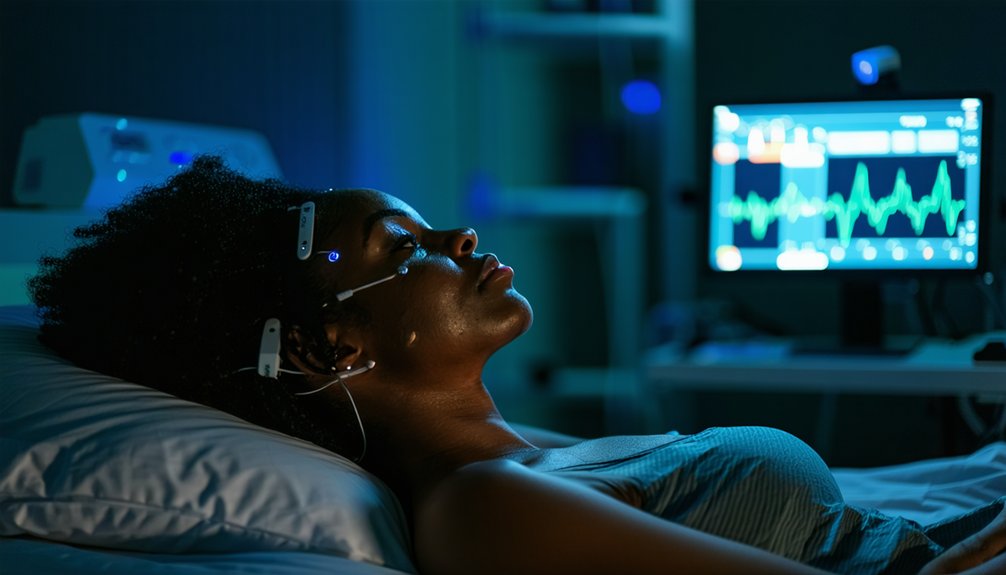
Because standard diagnostic tools weren’t built with you in mind, getting an accurate OSA diagnosis as a Black woman often takes longer and requires more scrutiny than it should.
Doctors often underestimate your symptom severity, even though you’re more likely to present with higher apnea-hypopnea indices. This isn’t accidental—implicit bias shapes how your reported fatigue and sleep disruption get interpreted.
The Epworth Sleepiness Scale wasn’t validated on Black populations, so your scores may be misread. Pulse oximetry, too, misses hypoxemia events in darker skin, meaning you could have OSA that never gets flagged by desaturation criteria alone.
That’s why customized screening matters. A prediction model built specifically for African Americans—factoring in snoring, restless sleep, and neck circumference—outperforms generic tools and gives you a real shot at accurate detection.
CPAP, Surgery, and Other Treatment Options
Getting diagnosed is only half the battle—treatment brings its own set of obstacles. CPAP adherence rates run lower among Black patients, often tied to socioeconomic barriers and inconsistent access. Mask fit matters more than you’d think: leaking masks, stretched straps, and constant readjustment push people away from treatment. Get properly fitted, lean on your support system, and don’t ignore discomfort—demand a fix.
Surgery isn’t automatically the answer either. Adenotonsillectomy shows lower success rates and higher complication risks for Black patients compared to White patients.
Good news: alternatives exist. Upper airway stimulation and oral appliance therapy show no adherence gap by race. Ask about telemedicine follow up, automated CPAP feedback, and culturally adapted coaching—these tools close gaps and keep you in control of your care.
Building a Sleep Apnea Care Plan That Works
Since no single fix solves sleep apnea, you need a plan that hits every angle at once—community trust, systemic access, treatment adherence, and daily habits working together.
Start with peer mentorship: connect with others navigating the same diagnosis so you’re not isolated with a mask on your face and no one to call.
Solve transport logistics upfront—if the sleep lab sits across town in an affluent zip code, arrange rides or telehealth options before you miss appointments.
Layer in real adherence support: interpreters when needed, monitoring apps that track your usage, and honest conversations about mask discomfort or stigma.
Then build daily habits—weight management, side sleeping, cutting alcohol—that reinforce the medical treatment.
Your care plan works when every piece backs the others up.
Frequently Asked Questions
Can Untreated Sleep Apnea Affect Fertility or Pregnancy Outcomes in Black Women?
Yes, it can. You’re facing real fertility impacts—OSA raises infertility risk 2.1-fold and disrupts ovulation. You’re also more vulnerable to pregnancy complications like gestational hypertension and preeclampsia. Treating your OSA reclaims your reproductive power and protects your health.
Does Insurance Typically Cover CPAP Machines and Sleep Apnea Treatment Costs?
Yes, you’ll typically get insurance coverage for CPAP therapy as durable equipment once you have a sleep study diagnosis and prescription. Medicare, Medicaid, and private plans usually share costs—reclaim your rest, you’ve earned this care.
How Much Does a Home Sleep Apnea Test Versus In-Lab Study Cost?
You’ll pay $150-$1,000 for home testing versus $1,000-$10,000 for in-lab studies. This cost comparison shows home tests run roughly 21% of clinic prices—giving you an affordable, convenient path to answers without breaking your budget.
Can Children Inherit Sleep Apnea Risk From a Mother With OSA?
Yes—you can pass on genetic predisposition for OSA, including inherited airway and craniofacial traits. If you have OSA, don’t wait: prioritize family screening for your kids. Knowledge is power—claim your family’s health freedom now.
What Questions Should I Ask My Doctor at a Sleep Apnea Appointment?
Ask about testing options, AHI severity, medication interactions with sleep aids, and lifestyle adjustments that enhance treatment success. Demand answers on CPAP alternatives, comorbidity screening, and follow-up timelines—you deserve thorough care, not dismissal.
Conclusion
You don’t have to fit the “classic” snoring mold to have sleep apnea. If you’re dealing with fatigue, morning headaches, mood swings, or frequent nighttime bathroom trips, don’t brush them off. Talk to your doctor, ask about a sleep study, and push for answers if symptoms persist. Early diagnosis and the right treatment—whether CPAP, lifestyle changes, or surgery—can protect your heart, your energy, and your long-term health.
References
- https://www.neurologyadvisor.com/features/racial-inequality-of-sleep-black-women/
- https://www.inspiresleep.com/en-us/blog/sleep-apnea-symptoms-in-women/
- https://aasm.org/osa-symptoms-more-common-among-african-american-women-than-caucasians/
- https://pmc.ncbi.nlm.nih.gov/articles/PMC4602395/
- https://pmc.ncbi.nlm.nih.gov/articles/PMC6187109/
- https://www.blackhealth.org/articles/sleep-apnea-black-adults-signs/
- https://blackdoctor.com/women-sleep-apnea-symptoms-clinical-trial/
- https://academic.oup.com/annalsats/article/19/2/272/8419085
- https://pmc.ncbi.nlm.nih.gov/articles/PMC8329940/pdf/nihms-1609339.pdf
- https://www.bhexplained.org/blog/sleepapnea

