
Your watch tracks pulse changes and HRV to estimate arousal, but it can’t read your mind. Studies show weak links between device stress scores and how you actually feel—sometimes near zero correlation. That’s because excitement and anxiety trigger identical physiological signals: racing heart, faster breathing, sweat. Your device can’t tell the difference. It also misses context such as sleep debt, caffeine, or illness. Understanding what’s actually happening beneath that number changes how you should use it.
TLDR Key Takeaways
- Wearables measure autonomic arousal via HRV, EDA, and heart rate, not stress itself or its emotional meaning.
- Sensors can’t distinguish anxiety from excitement since both trigger similar sympathetic physiological responses.
- HRV explains only 1–2% of daily stress variance, showing weak links to self-reported experience.
- Large studies found zero correlation between device stress scores and how users actually felt.
- Use wearable data as a rough clue paired with self-reflection, not a definitive stress verdict.
How Your Watch Actually Measures Stress
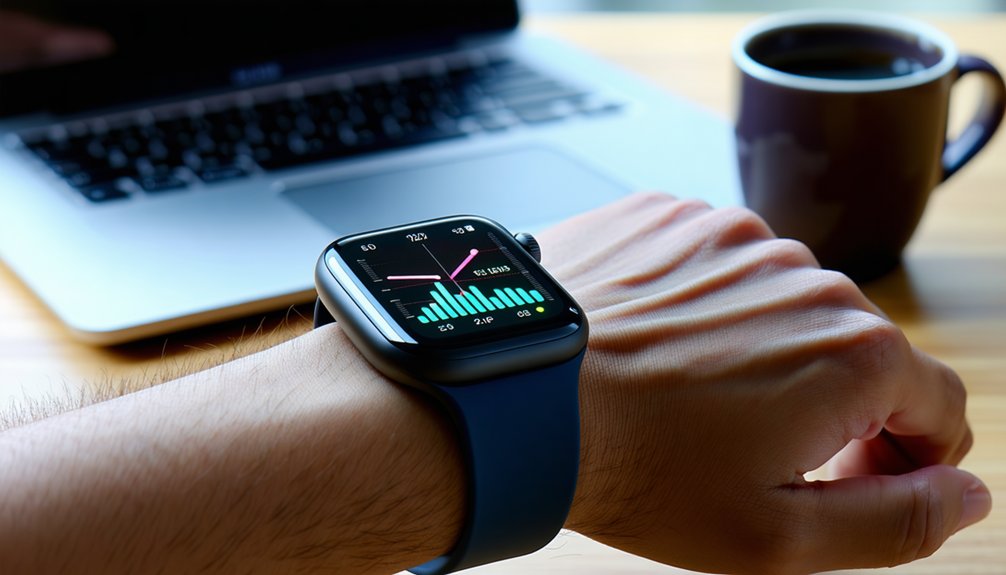
Because you can’t stick electrodes straight into your bloodstream, your watch relies on light instead. A PPG sensor beams green or infrared light into your skin, measuring how blood volume changes with each heartbeat. From these pulses, your watch derives HRV—the time between beats. Tighter, more rigid intervals signal stress; relaxed states show more variation.
Some watches add EDA sensors, sending a tiny current across your skin to catch sweat-related conductance shifts. Accelerometers step in too, separating a hard workout from genuine psychological strain. Many devices let you enable continuous measurement mode, though this convenience can come at the cost of battery life.
Here’s the catch: optical artefacts and loose sensor placement can throw everything off. If your watch isn’t snug, light readings scatter, and your “stress score” becomes noise dressed up as data. Fit matters as much as the tech itself. In fact, one recent study found the correlation between smartwatch stress scores and self-reported stress was basically zero. These readings also feed into a broader Energy Score that charts your perceived energy levels throughout the day.
Why HRV Is the Real Star Behind the Score
Once your watch captures those pulse-to-pulse intervals, HRV becomes the number doing the real analytical work. It’s not just a metric—it’s a direct window into your autonomic balance, the constant negotiation between your sympathetic “fight or flight” system and your parasympathetic “rest and recover” system.
Here’s what matters: when your parasympathetic branch dominates, you get higher, more varied HRV—your cardiac vagal activity signaling genuine recovery. When stress hormones take over, your heart beats more uniformly, dropping HRV and flagging alert mode. Left unchecked, this sustained sympathetic activation can also drive elevated blood pressure.
Metrics like RMSSD track this vagal influence specifically, which is why researchers trust it. Heart rate alone can’t capture this subtlety. HRV gives you the sensitivity to see your nervous system’s true state, not just guess at it. This is because RMSSD is calculated directly from precise beat-to-beat time measurements captured by the sensor.
Do Wearable Stress Scores Match How You Feel?
How well does your wearable’s stress score actually track what you’re feeling? Not very well. A study of 800 young adults using the Garmin Vivosmart 4 found zero correlation between stress scores and self-reported stress. Apple Watch users showed similarly weak links between HRV and lived experience. Researcher Eiko Fried called the connection “essentially nonexistent.” For 25% of users, the watch flagged stress that wasn’t there—or missed stress that was.
This perceived mismatch comes down to emotional granularity. Your device can’t tell excitement from anxiety, fear from arousal—it just sees a raised heart rate. Real stress lives in circumstances your watch can’t access: what you’re doing, who you’re with, why your body’s reacting. Numbers alone won’t hand you that understanding. Even the same physical exertion can mean different things, since exercise-induced stress produces cardiovascular patterns that look similar to but are physiologically distinct from psychological strain.
What Do Studies Actually Show?
What Do Studies Actually Show?
When you dig into the research, a clear pattern emerges: raw heart rate beats proprietary algorithms at predicting how stressed you actually feel.
Garmin’s Vivosmart 4 study of 800+ young adults found zero correlation between its stress score and self-reports. Apple Watch HRV readings? Fundamentally zero correlation too—your 30-second ECG snapshot can’t capture acute stress. HRV metrics explain just 1-2% of variance in daily stress, exposing serious measurement bias in these algorithms.
Sex differences and tonic HRV introduce situational factors that generic algorithms ignore entirely. This is largely because many consumer devices rely on wrist-worn PPG sensors, which are inherently less precise at capturing cardiac activity than chest-worn ECG alternatives.
One bright spot: Oura’s sleep data actually predicts stress—each extra hour of sleep cuts moderate-to-high stress odds by 38%. Researchers also found that each additional beat per minute in resting heart rate was linked to a 3.6% increased odds of experiencing stress. The takeaway? Your watch reads your body, not your mind.
Why Excitement Can Look Just Like Stress
Why can’t your wearable tell the difference between pre-race jitters and pre-deadline dread? Because your body doesn’t actually make one. Both states fire up your sympathetic nervous system: racing heart, rapid breathing, sweaty palms, muscle tension, a surge of adrenaline and cortisol. Your watch reads these signals as raw arousal—it can’t access the story behind them. This shared physiology exists because both excitement and anxiety trigger the same SAM axis, releasing norepinephrine and epinephrine that spike heart rate and arousal regardless of the emotional label attached.
That story is everything. Cognitive appraisal decides whether your brain tags a spike as threat or opportunity. Anxiety says danger; excitement says “bring it on.” This valence framing—unpleasant versus pleasant—happens in your head, not in your heart rate data. Control, situation, and mindset shape that interpretation, but your device only sees numbers, never the meaning you assign them. The amygdala activates in both states, while your prefrontal cortex draws on context and past experience to decide which label fits. Reframing that same arousal with curiosity rather than dread can shift the entire experience from anxiety toward excitement.
The Big Gap Between Lab and Real-Life Accuracy
Strip away the lab coats and electrode wires, and stress detection accuracy collapses. In controlled settings, algorithms hit 99.78% accuracy identifying stress from ECG, EDA, and respiration. Send that same model into your daily life, and pooled accuracy drops to 85.6%—sometimes far lower. This is deployment drift in action: models trained on staged stressors (like public speaking tests) fail to generalize once you’re commuting, working, or living normally.
The culprit is situational validity. Lab environments strip out real-world noise—caffeine, temperature, movement, emotional context—that your body encounters daily. Single-modality ECG sensors, for instance, drop from 80% lab accuracy to unreliable field performance. You’re not getting a diagnostic tool. You’re getting a rough estimate built for conditions you don’t actually live in.
Why HRV Alone Can’t Capture Full Stress
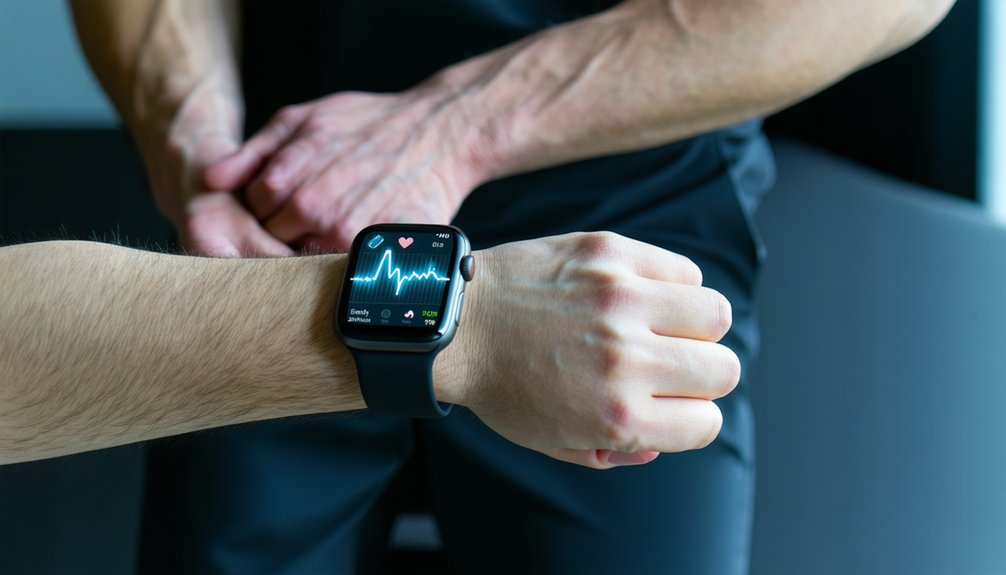
Because your wearable’s stress score often leans heavily on HRV, you’re only getting a partial portrait. HRV tracks parasympathetic activity within your heart—nothing more. It can’t tell you if that dip came from a hard workout, a poor night’s sleep, alcohol, illness, or genuine anxiety. This is where measurement semantics matter: a “low” number means different things depending on circumstances your watch simply doesn’t have.
These contextual limitations are real. Your device sees the physiological signal but misses the story behind it. Two people with identical HRV drops might be experiencing completely different stressors—one physical, one psychological. Even factors like menstrual cycle phase can significantly lower HRV without any true increase in psychological stress. It’s also worth remembering that HRV tends to decrease with increasing age, so an older person’s baseline reading naturally looks different from a younger person’s without signaling extra stress.
Freedom here means treating HRV as a clue, not a verdict. Pair it with how you actually feel, and you reclaim the interpretation.
Skin Temperature and EDA: The Next Sensors
Increasingly, wearables are pairing electrodermal activity (EDA) with skin temperature to fill in HRV’s blind spots. EDA tracks tiny shifts in skin conductivity as your sympathetic nervous system triggers sweat gland activity—a direct window into arousal that HRV can’t offer. But sweat localization means raw EDA alone can mislead you: heat, not stress, sometimes drives conductance changes.
That’s where skin temperature comes in. By syncing thermal data with EDA, your wearable corrects for thermal drift, isolating genuine stress signals from environmental noise. This pairing demands clean sensor contact, solid baselines, and artifact filtering to work well. In fact, this combined sensing approach is powerful enough that a recent retrospective analysis drew on nearly 10 million hours of continuous EDA data from almost 16,000 people to study population-level stress patterns. Done right, it separates tonic and phasic responses accurately—giving you a clearer, more honest readout of what your body’s actually experiencing, not just what the weather’s doing to it. Tonic activity, or SCL, reflects your baseline arousal, while phasic spikes, or SCR, capture rapid reactions to specific stimuli.
Could Your Phone Reveal More Than Your Heart Rate?
Your wearable isn’t the only device tracking your stress—your phone’s doing it too, just less directly. Phone signals reveal patterns you’d never notice yourself: screen activity between 6–9 PM, SMS frequency, mobility radius, call habits. Combined, these features hit over 75% accuracy in binary stress classification—sometimes climbing to 87.5% when paired with sensor data.
Then there’s sentiment typing. The negative words you type correlate strongly with lifetime stressors, both acute and chronic. Your typing volume alone links to perceived stress and even inflammation markers like sCRP. Your phone’s microphone adds another layer, picking up voice changes tied to stress physiology.
You’re generating data constantly, whether you’re aware of it or not. Your phone already knows more than you think.
How to Read Stress Trends, Not Daily Scores
Before any score means something, you need a baseline. Wear your device for two weeks straight, tracking resting heart rate, HRV, stress scores, and sleep. This builds baseline patterns unique to you, revealing what’s normal versus what’s noise.
Once you know your range, stop reacting to single spikes. One bad night doesn’t matter—three-day clusters do. Overnight HRV stays reliable; daytime readings get noisy from regular activity. Treat the daily score as a directional hint, not gospel.
When you spot a real deviation, hunt for behavioral circumstances immediately. Did you travel, eat late, drink alcohol, or push through a stressful deadline? Test one variable at a time—earlier dinners, say—and watch how metrics shift. That’s how you turn data into freedom, not anxiety.
What Wearable Stress Data Still Gets Wrong
Because heart rate and HRV shift with any kind of arousal, your wearable can’t tell excitement from anxiety—joy, a tense deadline, and sexual arousal all look alike on a graph. This is sensor bias in action: one physiological signal trying to represent wildly different emotional states.
Then there’s situational blindness. Your watch doesn’t know you skipped sleep, drank three coffees, or caught a cold—all factors that skew HRV independent of stress. Studies confirm the fallout: Garmin and Apple Watch data show little to no correlation with self-reported stress. HRV explains just 1–2% of daily stress variance in real life.
The algorithms behind these scores stay proprietary and unverified, so you’re trusting a black box. Bottom line: your watch reads arousal, not truth.
Using Your Stress Score Without Overtrusting It
Since a stress score can’t diagnose anything, treat it as a compass rather than a verdict. Watch for week-over-week trends instead of reacting to single spikes—daytime noise from movement and talking skews point-in-time readings. When your score climbs, use it as a cue: breathe, hydrate, move outside. Don’t wait for a crisis alert.
Build metric literacy by logging circumstances—deadlines, poor sleep, caffeine—so your data means something instead of just flashing numbers at you. Your watch can’t tell excitement from anxiety; your notes can.
Practice mindful detachment too. Turn off notifications that create pressure, schedule no-data weekends, and remember the score is a rough guide, not your identity. You’re the one interpreting the pattern—not the algorithm defining you.
Frequently Asked Questions
Can Wearable Stress Scores Diagnose Anxiety or Mental Health Disorders?
No—your watch can’t replace clinical diagnosis or psychiatric evaluation. It flags patterns worth noticing, but you deserve real answers. Use these scores as a prompt to seek professional care, not as a verdict on your mental health.
Do Different Wearable Brands Calculate Stress Scores Using the Same Method?
No, you won’t find a shared standard. Each brand builds proprietary algorithms, mixing heart rate and HRV differently. Sensor variability across devices means your Garmin and your friend’s Apple Watch simply aren’t speaking the same language.
How Often Should I Check My Stress Score for Meaningful Insights?
Check daily patterns at consistent times—don’t chase hourly blips. Review twice daily for 3–5 minutes, then step back weekly. You’ll spot long term trends, not noise, and reclaim your data from obsessive checking.
Can Medications or Caffeine Affect My Wearable’s Stress Readings?
Yes—both skew your readings substantially. Caffeine effects spike your heart rate, mimicking stress signals your watch can’t distinguish from real anxiety. Medication interference (stimulants, beta blockers) further distorts HRV accuracy. Trust your intuition over the algorithm; you know your body best.
Should I Consult a Doctor if My Stress Score Stays High?
Yes. If your overnight stress score stays consistently high (76–100), don’t just watch the number—seek evaluation from your doctor. Track trends over weeks, not single readings, and discuss possible sleep apnea or chronic stress causes.
Conclusion
Your watch isn’t lying to you, but it isn’t reading your mind either. It’s tracking HRV and calling it “stress,” even when you’re just excited or exercising. Don’t chase daily scores—watch the trends over weeks. Use the data as a nudge to check in with yourself, not as a verdict. Pair it with how you actually feel, and you’ll get a clearer portrait than the algorithm alone can give you.
References
- https://pmc.ncbi.nlm.nih.gov/articles/PMC12647429/
- https://www.reddit.com/r/Garmin/comments/1mns3wx/smartwatches_are_useless_for_measuring_actual/
- https://www.reddit.com/r/Garmin/comments/1oppy61/is_garmin_stress_levels_accurate_each_time_i/
- https://forums.garmin.com/outdoor-recreation/outdoor-recreation/f/epix-2/331293/stress-accuracy
- https://www.linkedin.com/pulse/stress-scores-exposed-why-your-wearable-gets-wrong-how-civello-4enuc
- https://www.theguardian.com/technology/2025/aug/08/smartwatches-offer-little-insight-into-stress-levels-researchers-find
- https://pmc.ncbi.nlm.nih.gov/articles/PMC10867751/
- https://mhealth.jmir.org/2026/1/e64144
- https://pmc.ncbi.nlm.nih.gov/articles/PMC9654418/
- https://www.samsung.com/us/support/answer/ANS10001394/

